

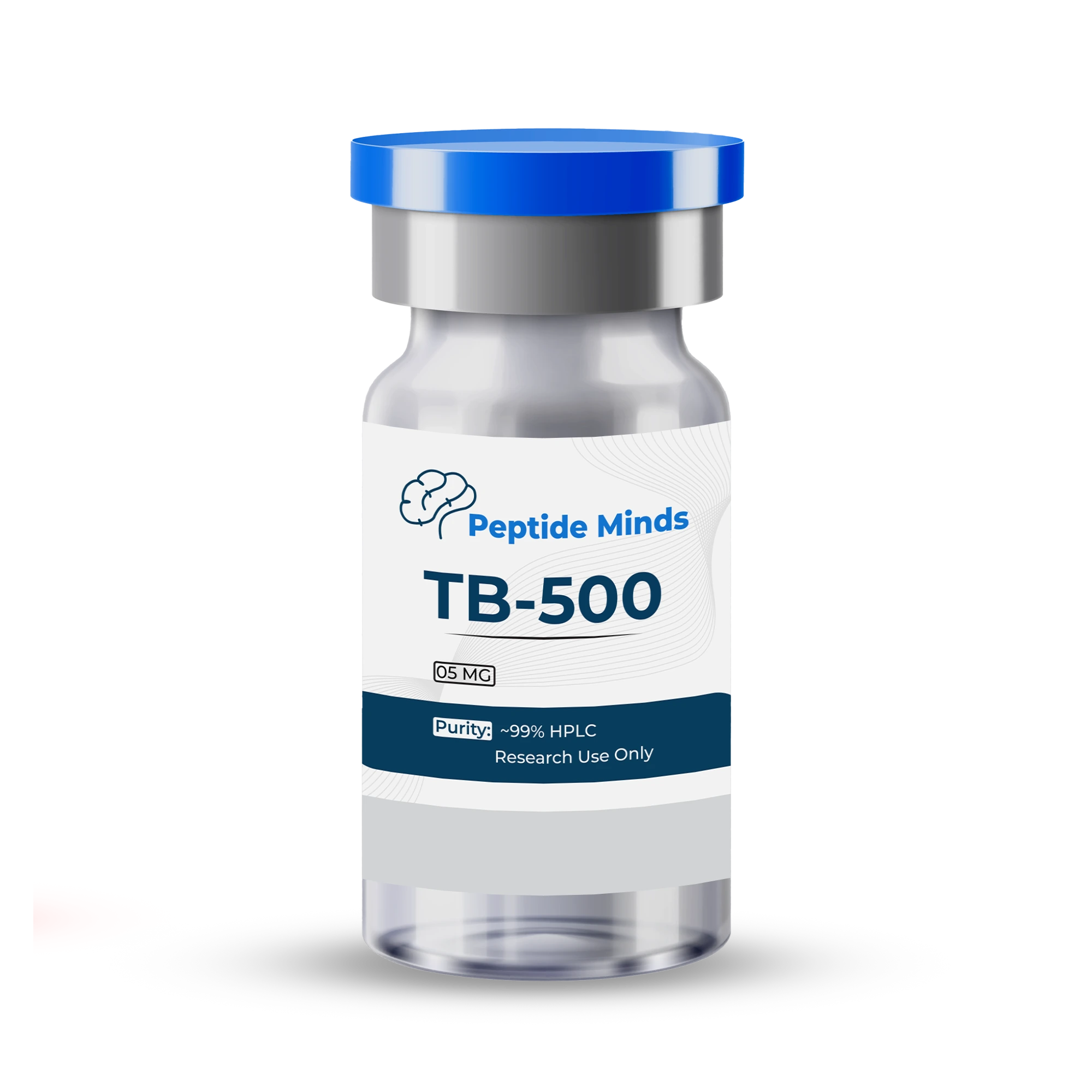
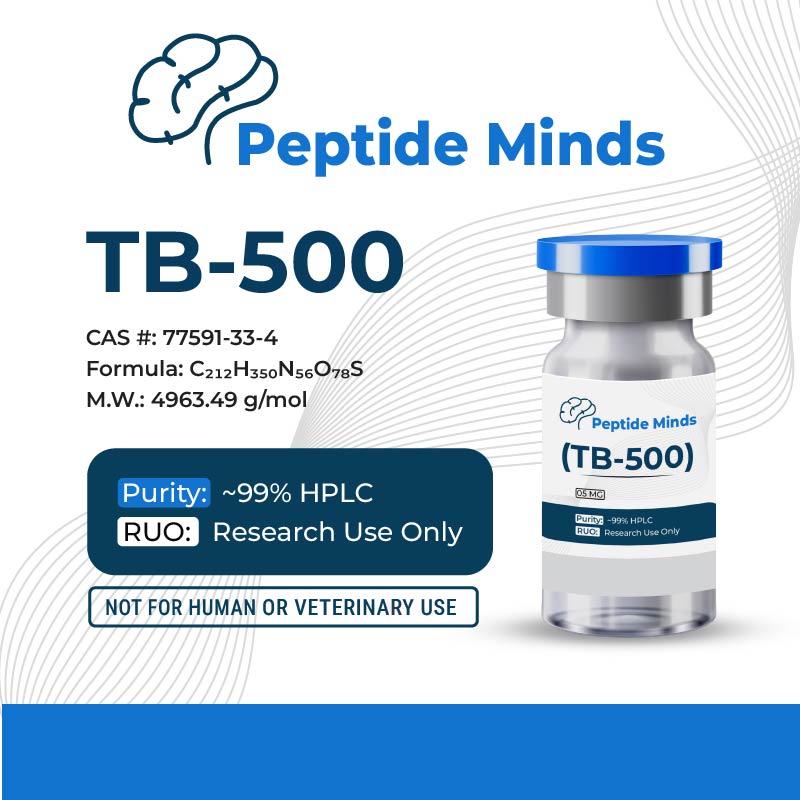
TB-500
$62.00
10mg of reagent-grade TB-500.
Third Party Verified
Description
⚠️ LABORATORY RESEARCH USE ONLY
NOT FOR HUMAN OR ANIMAL CONSUMPTION
This product is intended exclusively for in vitro research and analytical applications in professional laboratory settings.
NOT approved by FDA for human use. NOT for clinical, diagnostic, or therapeutic purposes.
Product Specifications – TB-500 (Thymosin β4 Fragment)
| Field | Details |
| Product Name | TB-500 (Ac-LKKTETQ) Synthetic peptide corresponding to the active actin-binding region of Thymosin β4 |
| Category | Synthetic heptapeptide fragment of Thymosin β4 Research peptide for cellular migration and angiogenesis pathway studies |
| Peptide Length | 7 amino acids (heptapeptide) |
| Amino Acid Sequence | Ac-Leu-Lys-Lys-Thr-Glu-Thr-Gln (Ac-LKKTETQ) |
| Molecular Formula | C₃₈H₆₈N₁₀O₁₄ |
| Molecular Weight | ≈ 889.02 Da |
| Form & Purity | Lyophilized powder; purity ≥95% (HPLC-verified) |
| Storage | Lyophilized: ≤ –20°C long-term, dry Reconstituted: ~4°C for 10–14 days Avoid repeated freeze-thaw cycles |
| Compliance Status | Not FDA-approved. Prohibited by WADA (anti-doping). Available only for research use. |
Molecular Mechanism Research
TB-500 is studied in controlled laboratory settings for its interactions with actin-binding pathways and cellular signaling mechanisms. Research focuses on molecular pathway investigations in in vitro cell culture models and preclinical systems.
Actin-Binding & Cellular Migration Studies
Laboratory research examines TB-500’s binding interactions with G-actin and effects on actin polymerization dynamics in cell culture systems. Studies investigate cellular migration mechanisms and cytoskeletal remodeling pathways in various cell types.
Angiogenesis Pathway & Matrix Remodeling Research
Preclinical research investigates TB-500’s effects on multiple signaling pathways in laboratory models:
- Integrin-Linked Kinase (ILK) Pathway: Studies examine ILK activation and downstream Akt pathway signaling in endothelial cell cultures
- VEGF Expression Research: Investigations of vascular endothelial growth factor expression in angiogenesis models
- Matrix Metalloproteinases (MMPs): Research on MMP activity in extracellular matrix remodeling studies
- Laminin Expression: Studies of laminin-332 synthesis and basement membrane protein expression in cell culture
Research models examine endothelial differentiation mechanisms, capillary formation pathways in vitro, and tissue granulation processes in laboratory conditions. [1]
PI3K-Akt-mTOR Pathway Investigations
Recent laboratory studies investigate TB-500’s effects on:
- PI3K-Akt-mTOR signaling cascade activation in cellular assays
- HIF-1α (Hypoxia-Inducible Factor 1-alpha) pathway interactions in hypoxia models
- Vascular proliferation mechanisms in endothelial cell research
- Metabolic support pathways in tissue culture systems
These pathway investigations in controlled laboratory conditions examine pro-migratory and pro-angiogenic signaling mechanisms in various cell types. [2]
Inflammatory Mediator & Cell Survival Research
Laboratory models study TB-500’s effects on:
- Cytokine expression modulation in inflammatory cell culture models
- Neutrophil adhesion mechanisms in leukocyte migration studies
- Apoptosis pathway regulation in cell survival assays
- Cell survival signaling pathways in tissue culture
- Necrosis biomarker studies in cellular damage models
Research examines inflammatory response pathways and regenerative remodeling mechanisms in controlled in vitro environments. Multiple experimental models investigate functional outcome measures in laboratory systems. [3]
Preclinical Research Applications
TB-500 has been investigated in various preclinical research models:
Dermal & Epithelial Research Models
Published animal studies have examined:
- Reepithelialization mechanisms in rodent wound models
- Angiogenesis pathway activation in tissue repair studies
- Tensile strength measurements in biomechanical research
- Keratinocyte migration in cell culture systems
- Collagen deposition pathways in fibroblast studies
Topical and systemic administration routes have been investigated in preclinical research protocols. [4]
Ophthalmic Research
Clinical research with full-length Thymosin β4 (not TB-500 fragment) has been conducted:
- A randomized controlled trial investigated RGN-259 (Thymosin β4 0.1% ophthalmic solution)
- Research examined corneal healing mechanisms in neurotrophic keratopathy models
- Studies assessed ocular comfort parameters in dry eye populations
- Safety profiles were evaluated in ophthalmologic research settings
Note: This research utilized full-length Thymosin β4, not the TB-500 fragment. Results may not be directly applicable to TB-500. [5]
Additional Preclinical Investigation Areas
Exploratory preclinical models have investigated TB-500 in:
- Myocardial injury models examining cardiac tissue pathways
- Spinal cord injury research studying neural pathway mechanisms
- Traumatic brain injury models investigating neuroprotective pathways
- Hair follicle development studies in dermatological research
These represent early-stage preclinical investigations in animal models. Human systemic data remains extremely limited. [6]
⚠️ Research Data Limitations
Important Context: Most evidence derives from animal studies or ophthalmic trials using full-length Thymosin β4 (not TB-500 fragment).
Human Data: No robust randomized controlled trials exist for systemic TB-500 administration in humans.
Clinical Validation: TB-500 lacks formal human clinical validation for any therapeutic application.
Laboratory Handling & Quality Considerations
Storage Protocol:
- Store lyophilized powder at ≤ –20°C in dry conditions
- Reconstitute using appropriate sterile technique
- Maintain reconstituted solutions at ~4°C
- Use reconstituted material within 10–14 days
- Avoid repeated freeze-thaw cycles
- Create aliquots for single-use applications
Quality Verification:
- Certificate of Analysis (COA) verification essential for research applications
- HPLC purity confirmation recommended (≥95%)
- GMP manufacturing verification important for consistent research results
- Peptide content validation through mass spectrometry when possible
- Sterility testing for cell culture applications
Note: Online peptide sources may contain variable peptide content, impurities, or sterility concerns. Always verify quality documentation for research applications.
Research Considerations from Literature
Observations from Animal Research:
Published preclinical studies generally report tolerability in animal models with topical or systemic administration routes. Some research protocols note mild injection site observations in certain experimental conditions.
Theoretical Research Considerations:
- Angiogenesis pathway activation: Research models investigating pro-angiogenic mechanisms raise theoretical considerations for proliferative disease research models
- Cell migration studies: Enhanced migratory signaling in laboratory conditions suggests potential cellular behavior considerations in various research contexts
- Long-term safety profiles: Extended duration studies in animal models remain limited in published literature
Important: These represent theoretical considerations from research pathway investigations, not established clinical risk profiles.
⚠️ Regulatory & Compliance Status
NOT FDA-APPROVED: TB-500 is not approved by FDA for any therapeutic indication.
WADA PROHIBITED: Listed as prohibited substance by World Anti-Doping Agency due to potential performance-related effects.
RESEARCH USE ONLY: Available exclusively for laboratory research with proper ethical oversight.
NOT FOR THERAPEUTIC USE: Not approved for human or veterinary therapeutic applications.
Research References
⚠️ CITATION NOTICE: The following references represent published scientific research conducted in controlled preclinical and laboratory settings. These studies do not represent approved clinical applications and are provided for research reference purposes only.
- Xing, Y., Ye, Y., Zuo, H., & Li, Y. (2021). Progress on the Function and Application of Thymosin β4. Frontiers in Endocrinology, 12, 767785. https://doi.org/10.3389/fendo.2021.767785
- Philp, D., Goldstein, A. L., & Kleinman, H. K. (2004). Thymosin beta4 promotes angiogenesis, wound healing, and hair follicle development. Mechanisms of Ageing and Development, 125(2), 113–115. https://doi.org/10.1016/j.mad.2003.11.005
- Sosne, G., & Berger, E. A. (2023). Thymosin Beta 4: A Potential Novel Adjunct Treatment for Bacterial Keratitis. International Immunopharmacology, 118, 109953. https://doi.org/10.1016/j.intimp.2023.109953
- Malinda, K. M., Sidhu, G. S., Mani, H., Banaudha, K., Maheshwari, R. K., Goldstein, A. L., & Kleinman, H. K. (1999). Thymosin beta4 accelerates wound healing. The Journal of Investigative Dermatology, 113(3), 364–368. https://doi.org/10.1046/j.1523-1747.1999.00708.x
- Sosne, G., Kleinman, H. K., Springs, C., Gross, R. H., Sung, J., & Kang, S. (2022). 0.1% RGN-259 (Thymosin β4) Ophthalmic Solution Promotes Healing and Improves Comfort in Neurotrophic Keratopathy Patients in a Randomized, Placebo-Controlled, Double-Masked Phase III Clinical Trial. International Journal of Molecular Sciences, 24(1), 554. https://doi.org/10.3390/ijms24010554
- Xiong, Y., Mahmood, A., Meng, Y., Zhang, Y., Zhang, Z. G., Morris, D. C., & Chopp, M. (2012). Neuroprotective and neurorestorative effects of Thymosin beta 4 treatment following experimental traumatic brain injury. Annals of the New York Academy of Sciences, 1270, 51. https://doi.org/10.1111/j.1749-6632.2012.06683.x
Research Peptide Summary
TB-500 is a synthetic heptapeptide fragment utilized in controlled laboratory investigations of actin-binding mechanisms, angiogenesis pathways, cellular migration research, and extracellular matrix remodeling studies.
Visit Peptide Minds for additional high-purity, third-party tested research compounds.
Additional information
| Size | 10 MG |
|---|---|
| Quantity | 1 VIAL, 2 VIALS, 5 VIALS, 10 VIALS |
Reviews
There are no reviews yet.