

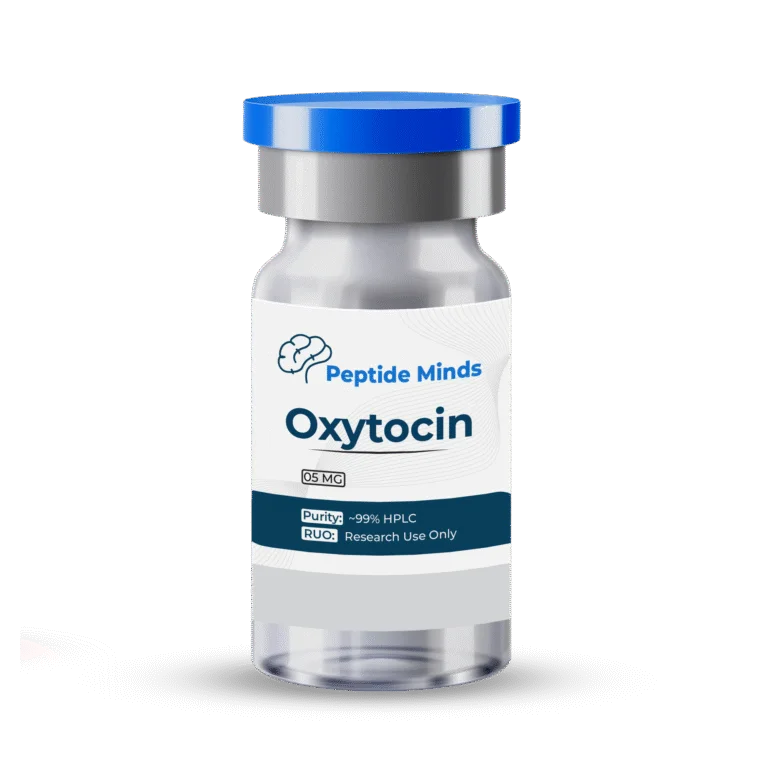
Description
Oxytocin – Neuropeptide Hormone & Uterotonic Agent
It is a cyclic nonapeptide hormone synthesized in the hypothalamus and secreted by the posterior pituitary. It acts as both a neurotransmitter and hormone, binding to oxytocin receptors (OXTR), which are G-protein coupled receptors. Oxytocin regulates uterine contraction, parturition, milk ejection reflex, and social-affiliative behaviors. Synthetic oxytocin (10 mg) is widely used in research for reproductive biology, neuroendocrine studies, and behavioral neuroscience.
Product Summary – Oxytocin (10 mg)
| Parameter | Specification |
| Category | Cyclic nonapeptide; hypothalamic neuropeptide; uterotonic hormone |
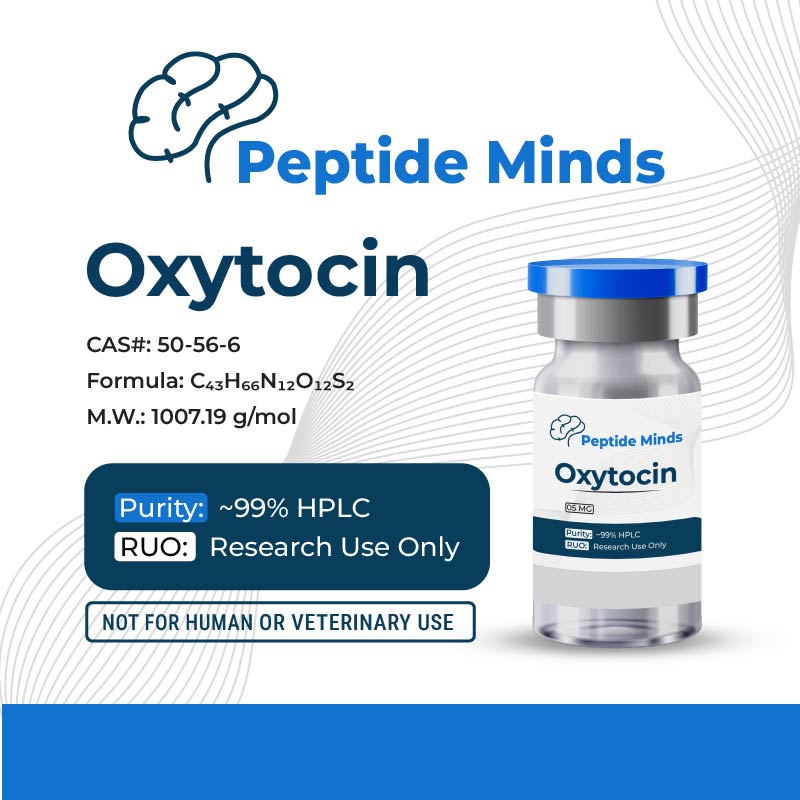
| Molecular Formula | C₄₃H₆₆N₁₂O₁₂S₂ |
| Molecular Weight | 1007.19 g/mol |
| Sequence | Cys-Tyr-Ile-Gln-Asn-Cys-Pro-Leu-Gly-NH₂ |
| Disulfide Bridge | Between Cys1 and Cys6 |
| Form & Purity | Lyophilized powder; ≥98% purity (HPLC-verified) |
| Storage | Store lyophilized at −20 °C, protected from light/moisture; reconstituted solution at −80 °C |
| Solubility | Soluble in sterile water or dilute acetic acid |
Mechanism of Action
It binds to the oxytocin receptor (OXTR), a class A GPCR, leading to the activation of the phospholipase C–inositol triphosphate (IP₃)/diacylglycerol (DAG) pathway, resulting in increased intracellular Ca²⁺ release.
- In uterine smooth muscle → Ca²⁺ influx and myosin light-chain phosphorylation promote strong rhythmic contractions.
- In mammary alveoli → Contraction of myoepithelial cells facilitates milk ejection (let-down reflex).
- In CNS → Modulates amygdala and hypothalamic circuits, influencing social bonding, maternal behavior, stress regulation, and prosociality.
Recent structural studies highlight biased signaling of oxytocin towards Gq/11-coupled pathways, differentiating its effects from vasopressin at shared receptor sites.
Research Applications
- Reproductive Medicine & Obstetrics: Models of labor induction, uterine contractility studies, and post-partum hemorrhage prevention.
- Neuroendocrinology: Investigations on hypothalamic-pituitary axis, stress response, and maternal bonding.
- Behavioral Neuroscience: Studies of pair bonding, trust, empathy, and social recognition in animal and human models.
- Metabolic Research: Exploration of oxytocin’s role in appetite regulation, glucose metabolism, and energy expenditure.
- Psychiatric Research: Clinical investigations for autism spectrum disorder (ASD), social anxiety, PTSD, and depression.
Safety & Tolerability
- General Safety: It is generally well tolerated at research doses.
- Adverse Events (dose-dependent in clinical settings): Uterine hyperstimulation, transient hypotension, flushing, and tachycardia.
- Handling Precautions: Use sterile techniques during reconstitution. Avoid repeated freeze–thaw cycles.
- Compliance: For research use only. Not for human or veterinary administration outside controlled studies.
Oxytocin 10 mg serves as a critical research tool in endocrinology, neuroscience, reproduction, and behavioral sciences, bridging molecular receptor biology with translational medicine.
Selected References
- Gimpl, G., & Fahrenholz, F. (2001). The oxytocin receptor system: structure, function, and regulation. Physiological Reviews, 81(2), 629–683. https://doi.org/10.1152/physrev.2001.81.2.629
- Lee, H. J., Macbeth, A. H., Pagani, J. H., & Young, W. S. (2009). Oxytocin: the great facilitator of life. Progress in Neurobiology, 88(2), 127–151. https://doi.org/10.1016/j.pneurobio.2009.04.001
- MacDonald, K., & Feifel, D. (2013). Oxytocin’s role in anxiety: a critical appraisal. Brain Research, 1580, 22–56. https://doi.org/10.1016/j.brainres.2012.09.015
- Quintana, D. S., & Guastella, A. J. (2020). An allostatic theory of oxytocin. Trends in Cognitive Sciences, 24(7), 515–528. https://doi.org/10.1016/j.tics.2020.04.005
Explore our complete catalog of high-purity, third-party tested research compounds by visiting our main shop page for all your laboratory needs.



Reviews
There are no reviews yet.