

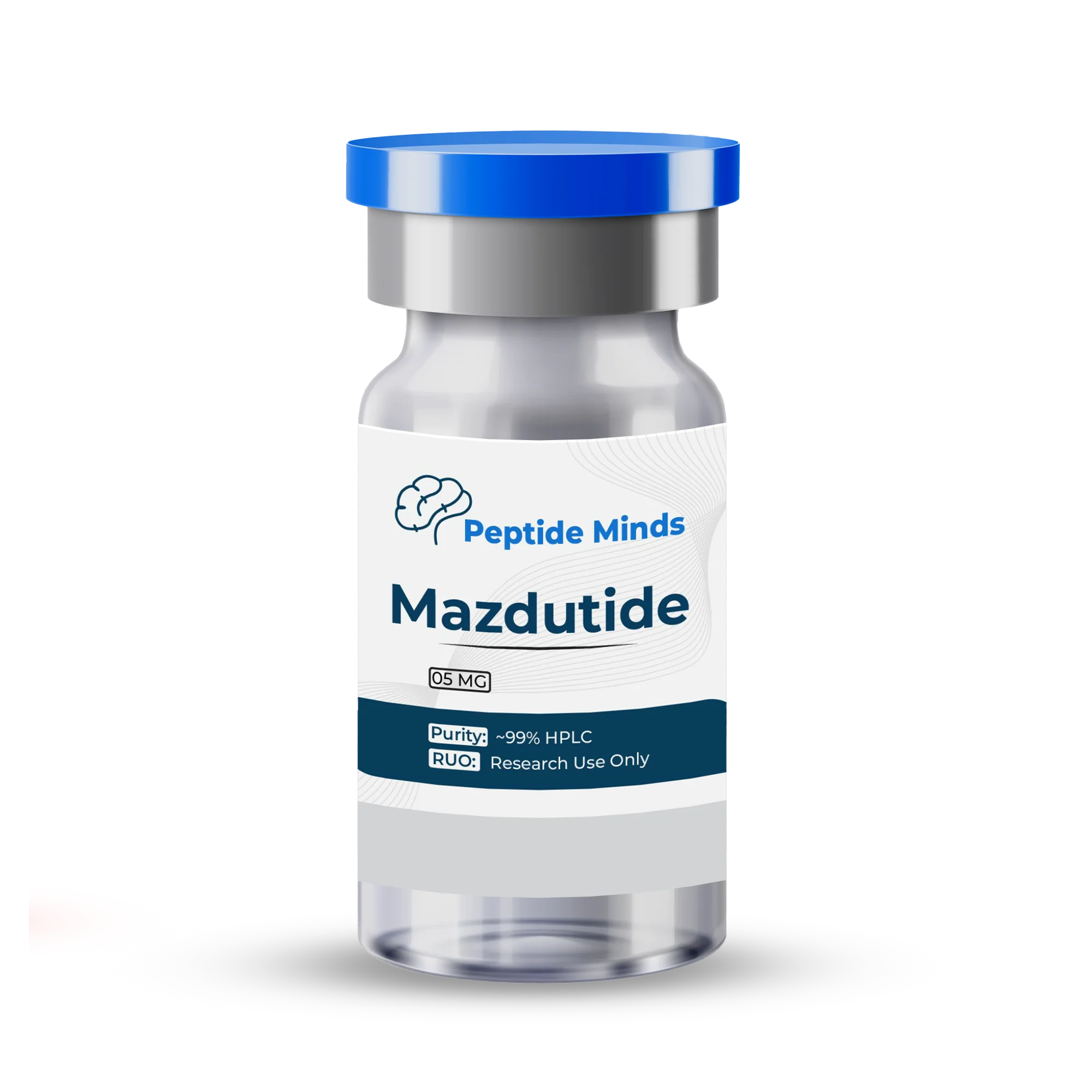
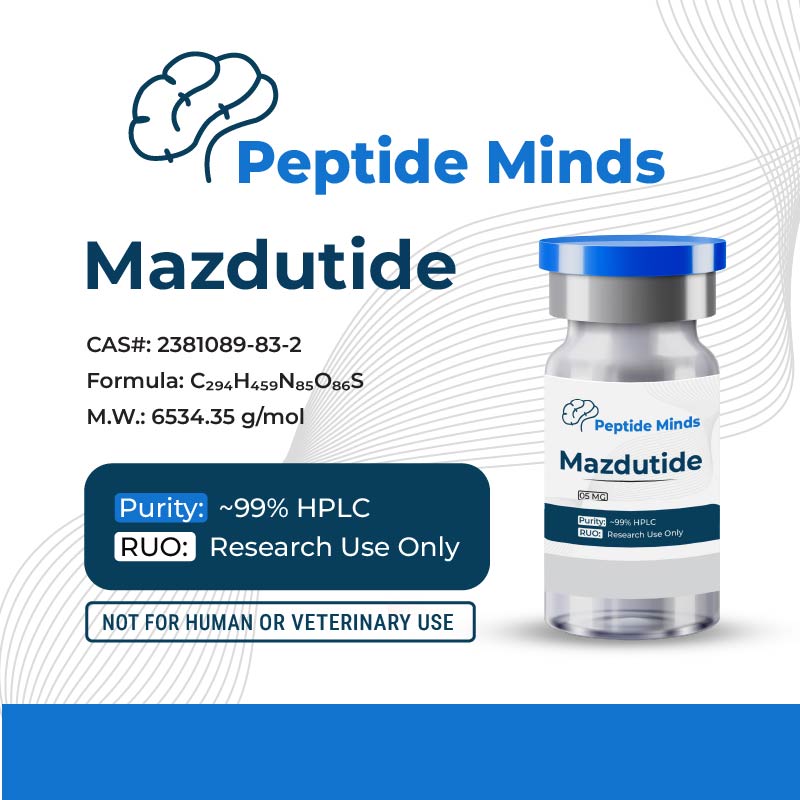
Mazdutide
$115.00
10mg of reagent-grade Mazdutide.
Third Party Verified
Description
Product Summary – Mazdutide – (IBI362 / LY3305677)
| Field | Details |
| Product Name | Mazdutide (IBI362; LY3305677) — a dual GLP-1 receptor (GLP-1R) and gluqagon receptor (GCGR) agonist |
| Category | Synthetic long-acting oxyntomodulin analog; dual incretin-gluqagon receptor agonist aimed at treating obesity and type 2 diabetes |
| Length / Structure | ~33–34 amino acid peptide with fatty-acyl (C20 diacid) conjugated via a hydrophilic linker (AEEA). Contains the non-coded amino acid Aib at position 2 |
| Molecular Formula | C₂₁₀H₃₂₂N₄₆O₆₇ |
| Molecular Weight | ≈ 4563.06 Da (free base) |
| Form & Purity | Lyophilized white/off-white powder; research-use grade, typically ≥98% purity (HPLC) |
| Storage | Store desiccated at ≤ −20 °C for long-term; reconstituted ≤ 4 °C for short term |
| Key Mechanisms of Action | – GLP-1R activation: stimulates glucose-dependent insulin release, reduces appetite, slows gastric emptying
– GCGR activation: increases energy expenditure, promotes lipolysis, enhances fatty liver metabolism |
| Research / Clinical Use Cases | – Phase 1b (Chinese subjects with T2D): significant HbA1c reduction (−1.46% to −2.23%) and weight loss (up to −5.4%) compared to dulaglutide and placebo
– Phase 3 obesity trials (GLORY-1): 4 mg and 6 mg arms met primary and secondary endpoints (≤48-week results), including sustained weight loss and cardio-metabolic improvements |
| Common AEs / Safety Signals | – Well tolerated, mild-to-moderate GI symptoms (nausea, vomiting, diarrhea, reduced appetite)
– Heart rate increases observed in all participants, but adverse events were transient—no discontinuations for safety reasons |
| Contraindications / Warnings | – Investigational in most countries.
– Regulatory approval limited (see below) – Typical precautions for incretin-based therapies apply (e.g., risk of GI side effects). – No known contraindications have been published yet. |
| Regulatory / Compliance | Approved in China in June 2025 for weight management
NDA accepted by China’s NMPA based on efficacy and favorable safety outcomes in Phase 3 trials |
Mechanism of Action of Mazdutide
Receptor Level Pharmacology
Mazdutide, as an oxyntomodulin class co-agonist, triggers dual cAMP signalling on the GLP-1R and GCGR. Preclinical literature shows that oxyntomodulin-like ligands have reduced intrinsic potency as compared to the native GLP-1 or gluqagon at their respective receptors. However, they achieve synergistic metabolic effects when both receptors are co-activated, leading to increased anorectic signaling and peripheral substrate utilization. These effects have a dose-responsive reduction in body weight and improvements in the glycemic and cardiometabolic risk markers. [1]
Dual GLP-1R/GCGR Engagment
Mazdutide, as a selective, long-acting, co-agonist at GLP-1R and GCGR, coordinates the anorectic and thermogenic programs. At the hypothalamic-brainstem circuits, GLP-1R activation by mazdutide decreases energy intake and increases satiety, and slows down the gastric emptying, resulting in a reduction of post-prandial glucose excursions and caloric intake.
In islets, GLP-1R increases the glucose-dependent insulin secretion and decreases the gluqagon secretion with beta-cell stimulus secretion improvement. Whereas GCGR signaling exerts a negative energy balance by elevating the energy expenditure and lipid oxidation, and promoting fatty acid mobilization and thermogenesis. The GLP-1R counterbalances the GCGR-mediated hepatic and glucose output, preserving glycemic control.
Tolerability and Safety Considerations of Mazdutide
- Phase 2–3 trials show a favorable safety profile with low discontinuation rates.
- Mild to moderate GI symptoms (nausea, diarrhea, vomiting), usually early and transient.
- Severe adverse events and hypoglycemia are uncommon, similar to placebo or dulaglutide.
- Small, clinically insignificant increases in heart rate; no CV risk identified.
Visit the site for more peptides products.
Citations
- Novikoff, A., & Müller, T. D. (2023). The molecular pharmacology of gluqagon agonists in diabetes and obesity. Peptides, 165, 171003. https://doi.org/10.1016/j.peptides.2023.171003
- Drucker D. J. (2022). GLP-1 physiology informs the pharmacotherapy of obesity. Molecular metabolism, 57, 101351. https://doi.org/10.1016/j.molmet.2021.101351
Additional information
| Quantity | 1 VIAL, 2 VIALS, 5 VIALS, 10 VIALS |
|---|---|
| Size | 10 MG |


Reviews
There are no reviews yet.