

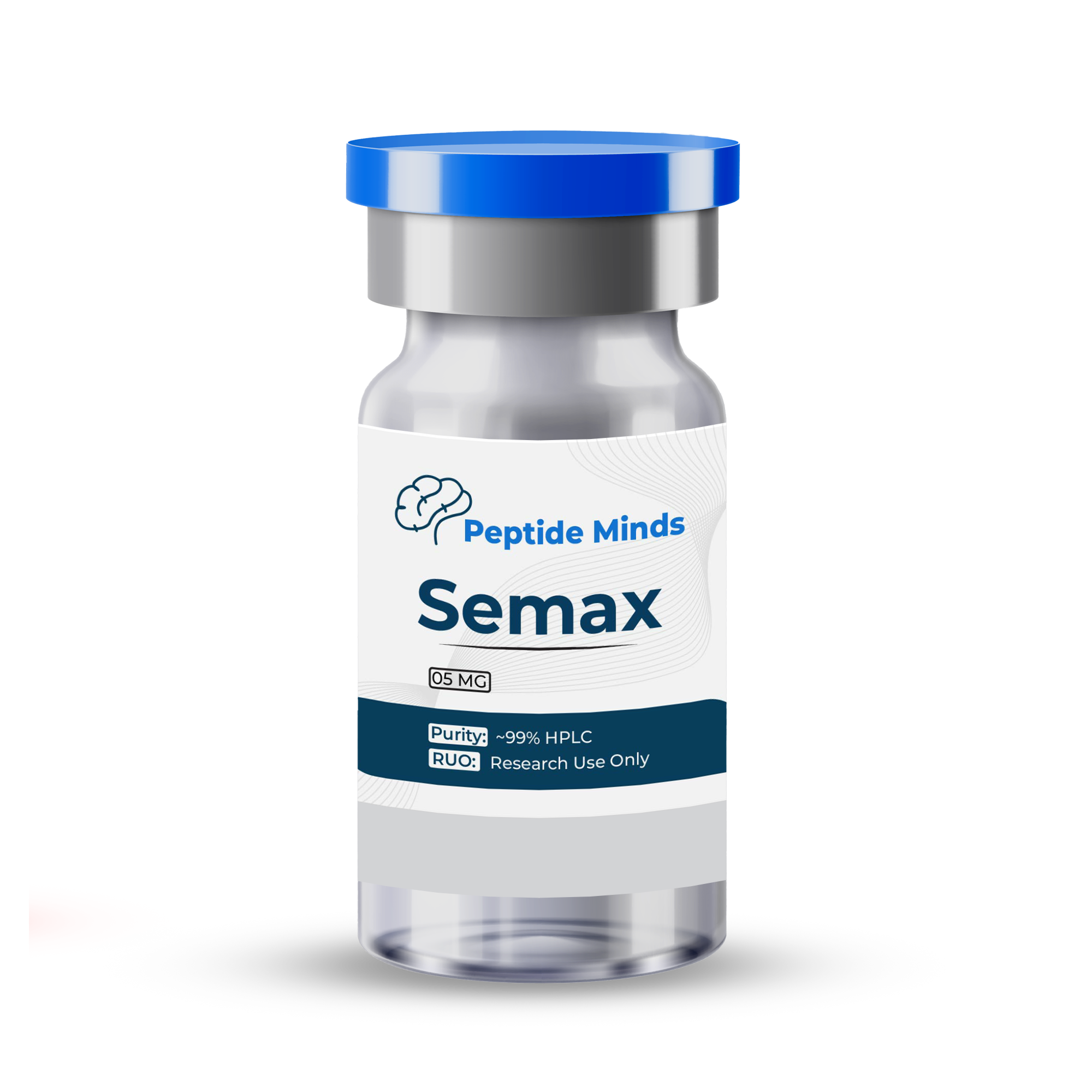
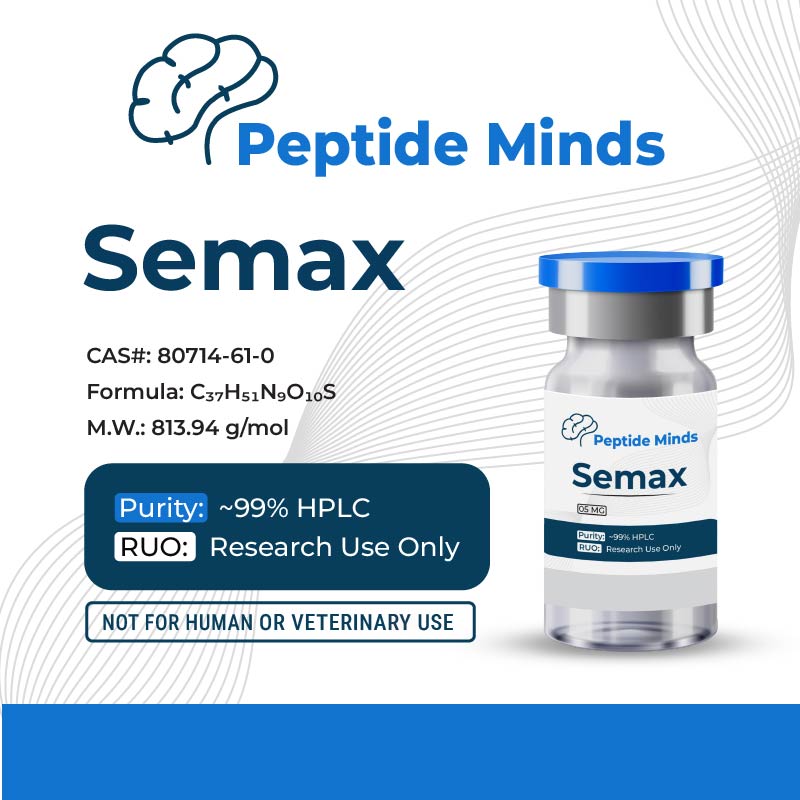
Semax
$28.00
Description
Product Summary- Semax – Neuroprotective and Nootropic Agent
| Field | Details |
| Product Name | Semax (Met-Glu-His-Phe-Pro-Gly-Pro; ACTH(4–10) analogue |
| Category | Synthetic neuropeptide; heptapeptide; neuroprotective and nootropic agent |
| Length | 7 amino acids (heptapeptide) |
| Amino Acid Sequence | Met-Glu-His-Phe-Pro-Gly-Pro (MEHFPGP) |
| Molecular Formula | C₃₇H₅₁N₉O₁₀S |
| Molecular Weight | ≈ 813.9–813.93 Da |
| Form & Purity | Lyophilized white powder; ≥95–98% purity by HPLC |
| Storage | Powder: store at ≤ –18 °C (stable for years). Reconstituted: store at 4 °C for days; avoid freeze-thaw |
| Typical Use / Administration | Intranasal delivery is typical; used in research for post-stroke recovery, cognitive enhancement; injectable routes are limited and for research only |
| Key Mechanisms | – Enhances BDNF expression and TrkB phosphorylation in the hippocampus; upregulates neurotrophin transcripts.
– Modulates gene expression associated with immune, vascular, ischemia-response networks in rat brain post-focal ischemia. – Demonstrates nootropic (learning, memory) and neuroprotective effects in rodent models; analgesic effects also noted. |
| Research / Clinical Use Cases | – Nootropic: improved attention/memory in humans after work-shift fatigue.
– Stroke recovery in Russian patients: elevated plasma BDNF linked to more effective rehabilitation. – Neuroprotective effects in rodent models: reduced infarct size and improved cognitive outcomes. |
| Common AEs / Safety Signals | Overall, well tolerated in clinical use; minimal side effects such as mild nasal irritation, headache, stimulation have been seen in Russian studies. |
| Contraindications / Warnings | Not FDA-approved; regulated mainly in Russia; available for research use only outside those markets; caution in overstimulation, sleep disruption. |
| Regulatory / Compliance | Approved in Russia; included in the Vital & Essential Drugs list since 2011; globally available only as a research peptide; not approved in the US/EU. |
Mechanism of Action of Semax
Semax is formulated as an intranasal application that bypasses the blood-brain barrier and acts rapidly by central exposure.
Induction of Neurotrophic Transcription and TrkB Activation
Multiple studies in rodents show that semax upregulates the mRNA transcription for BDNF and NGF, which enhances the TrkB expression and phosphorylation in the hippocampus and basal forebrain. TrkB engagement triggers the pro-survival and synaptic plasticity signaling pathways, such as MAPK/ERK, PI3K/Akt, and PLC-gamma, which are central to TLP, dendritic remodeling, and neuroprotection. [1]
These semax-induced upregulations of different signalling pathways provide the mechanistic bridge from molecular signalling to improved synaptic plasticity and functional recovery. The activation of MAPK/ERK and PI3K/Akt signalling leads to synaptic potentiation, dendritic spine stabilization, anti-apoptotic signalling, and metabolic resilience. These effects were observed to enhance learning, resistance to hypoxia, and ischemic tissue salvage in animal models.
Modulation of Monoaminergic System and Behaviour
Rodent model studies show that Semax induces acute to subacute changes in serotonergic and dopaminergic markers, as well as neurotransmission pathways involved in mood and cognition. These effects include anxiolytic- and antidepressant-like behavioral profiles, ultimately producing net nootropic and mood-stabilizing phenotypes. [3]
Tolerability and Safety Considerations of Semax
- Clinical trials (15–50 µg/kg intranasal) reported no serious adverse effects.
- Headache, nasal irritation, dizziness, insomnia, nausea, or anxiety.
- Extremely high doses (up to 1000 mg/kg) caused no mortality or organ damage.
- Preclinical models show no genetic or embryotoxic risks.
- Most safety data are short-term; chronic use has not been fully studied.
Citations
- Dmitrieva, V. G., Povarova, O. V., Skvortsova, V. I., Limborska, S. A., Myasoedov, N. F., & Dergunova, L. V. (2009). Semax and Pro-Gly-Pro Activate the Transcription of Neurotrophins and Their Receptor Genes after Cerebral Ischemia. Cellular and Molecular Neurobiology, 30(1), 71. https://doi.org/10.1007/s10571-009-9432-0
- Dolotov, O. V., Karpenko, E. A., Seredenina, T. S., Inozemtseva, L. S., Levitskaya, N. G., Zolotarev, Y. A., Kamensky, A. A., Grivennikov, I. A., Engele, J., & Myasoedov, N. F. (2006). Semax, an analogue of adrenocorticotropin (4-10), binds specifically and increases levels of brain-derived neurotrophic factor protein in rat basal forebrain. Journal of Neurochemistry, 97 Suppl 1, 82–86. https://doi.org/10.1111/j.1471-4159.2006.03658.x
- Vakhitova, Y. V., Kalinina, T. S., Zainullina, L. F., Lusta, A. Y., Volkova, A. V., Kudryashov, N. V., Gudasheva, T. A., Shimshirt, A. A., Kadnikov, I. A., Voronin, M. V., & Seredenin, S. B. (2021). Analysis of Antidepressant-like Effects and Action Mechanisms of GSB-106, a Small Molecule, Affecting the TrkB Signaling. International journal of molecular sciences, 22(24), 13381. https://doi.org/10.3390/ijms222413381
Explore our complete catalog of high-purity, third-party tested research compounds by visiting our main shop page for all your laboratory needs.
Additional information
| Size | 7 MG |
|---|---|
| Quantity | 1 VIAL, 2 VIALS, 5 VIALS, 10 VIALS |
Related products
-
-
-
-
SM-GLP1
Price range: $59.50 through $99.00Select options This product has multiple variants. The options may be chosen on the product page
Reviews
There are no reviews yet.