

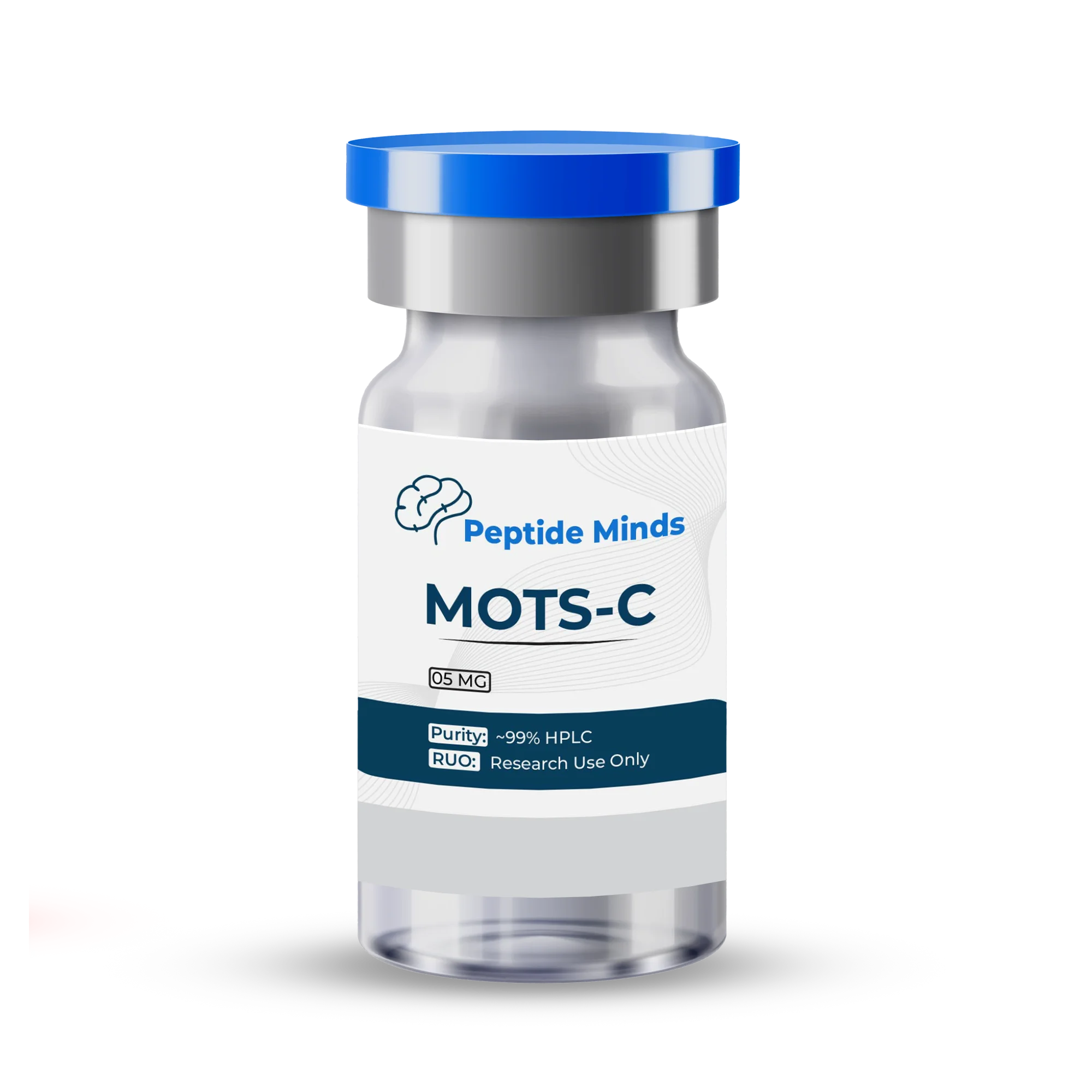
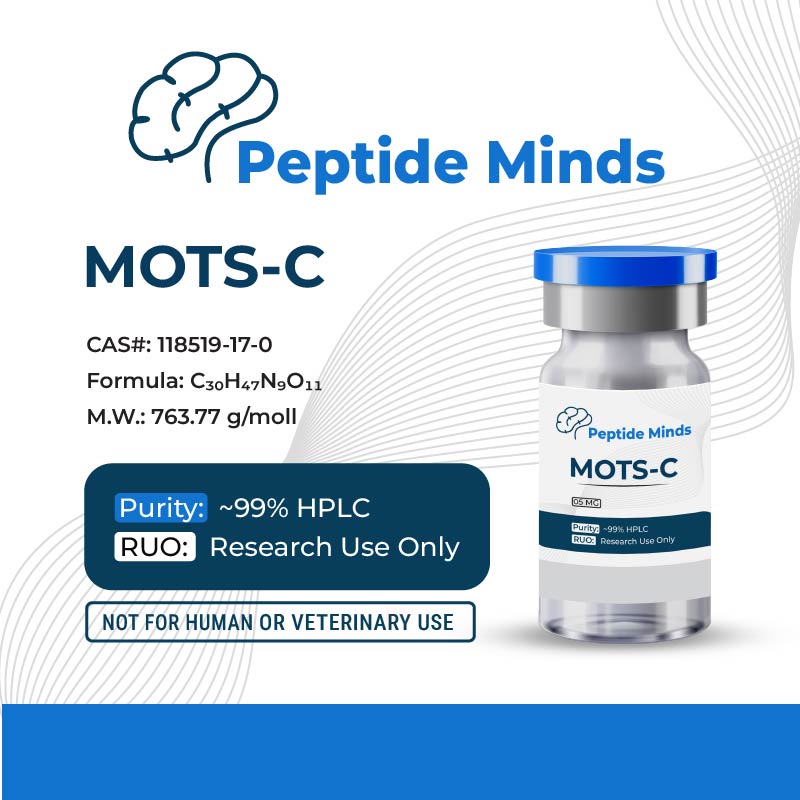
MOTS-C
$50.00
10mg of reagent-grade MOTS-C.
Third Party Verified
Description
Product Specifications – MOTS-c (Mitochondrial-Derived Peptide)
| Parameter | Details |
| Product Name | MOTS-c (Mitochondrial Open Reading Frame of the 12S rRNA-c) |
| Category | Mitochondrial-derived peptide for cellular metabolism research Investigational peptide for laboratory studies |
| Peptide Length | 16 amino acids |
| Amino Acid Sequence | MRWQEMGYIFYPRKLR |
| Molecular Formula | C₁₀₁H₁₅₂N₂₈O₂₂S₂ |
| Molecular Weight | ~2174 Da |
| Form & Purity | Lyophilized powder; ≥98% purity (HPLC-verified) |
| Storage | Lyophilized: –20°C to –80°C, protected from light/moisture Reconstituted: 4°C short-term; avoid repeated freeze-thaw cycles |
Research Background
MOTS-c is a mitochondrial-derived peptide encoded by the mitochondrial 12S rRNA gene. First identified in 2015, this 16-amino acid peptide is studied in laboratory research for its interactions with cellular metabolism pathways and mitochondrial function mechanisms.
Molecular Pathway Research Applications
Cellular Energy Metabolism & AMPK Pathway Studies
Laboratory research investigates MOTS-c’s effects on cellular energy metabolism through AMPK (AMP-activated protein kinase) pathway activation studies:
- AMPK Activation Research: Studies examine AMPK phosphorylation mechanisms in cell culture models
- Glucose Metabolism Pathways: Laboratory investigations of glucose uptake and utilization in cellular systems
- Mitochondrial Function Studies: Research on oxidative phosphorylation and ATP production mechanisms
- Metabolic Stress Response: Studies examining cellular adaptation to metabolic challenges in vitro
Research models examine how AMPK activation influences downstream metabolic pathways in controlled laboratory conditions. Studies investigate the role of folate-AICAR axis interactions in AMPK-mediated metabolic regulation mechanisms. [1]
Nuclear Translocation & Gene Expression Research
Recent laboratory studies investigate MOTS-c’s translocation mechanisms and nuclear localization patterns:
- Nuclear Import Studies: Research on nuclear translocation signals and transport mechanisms
- Gene Expression Analysis: Studies examining antioxidant response element (ARE) activation in cell culture
- Stress Response Pathways: Laboratory investigations of cellular stress response gene regulation
- Transcriptional Regulation Research: Studies on nuclear signaling pathways and gene expression modulation
Research examines stress-dependent nuclear translocation mechanisms and their role in regulating cellular antioxidant defense pathways in laboratory models. Studies investigate how nuclear MOTS-c interacts with metabolic gene regulatory networks. [2]
Mitochondrial Biogenesis & Function Research
Laboratory applications include studies of:
- Mitochondrial respiration capacity in cellular assays
- Oxidative stress response mechanisms in cell culture
- Mitochondrial membrane potential measurements
- Cellular ATP production pathway studies
- Mitochondrial DNA copy number investigations
Insulin Sensitivity & Metabolic Pathway Research
Preclinical research models investigate:
- Insulin signaling pathway components in cellular systems
- Glucose uptake mechanisms in muscle and adipose tissue culture
- Metabolic flexibility studies in various cell types
- Lipid metabolism pathway research in hepatocyte models
Studies examine MOTS-c’s effects on insulin-stimulated glucose uptake mechanisms and metabolic pathway regulation in controlled laboratory conditions.
Cellular Aging & Longevity Pathway Research
Investigational studies examine:
- Cellular senescence markers in culture models
- NAD+/NADH ratio measurements in metabolic research
- Mitochondrial function in aging cell culture systems
- Oxidative stress biomarkers in cellular aging models
- Sirtuin pathway interactions in longevity research
Laboratory research investigates age-related changes in mitochondrial peptide expression and their associations with cellular metabolic function in various experimental models.
Preclinical Research Models
MOTS-c has been investigated in various preclinical research contexts:
Metabolic Research Models
Animal studies have examined:
- Glucose tolerance test outcomes in mouse models
- Insulin sensitivity measurements in rodent research
- Body composition analysis in metabolic studies
- Energy expenditure measurements in animal models
- Physical endurance capacity assessments in exercise research
Note: All studies represent preclinical animal research and do not indicate human applications.
Skeletal Muscle Research
Laboratory investigations include:
- Muscle glucose uptake mechanisms in tissue culture
- Glycogen synthesis pathway studies
- Mitochondrial density measurements in muscle tissue
- Exercise adaptation pathway research in animal models
Adipose Tissue & Metabolic Research
Studies examine:
- Adipocyte metabolism in cell culture systems
- Thermogenic pathway investigations in brown adipose tissue models
- Lipid storage and mobilization mechanisms in research systems
- Inflammatory marker expression in adipose tissue culture
Hepatic Metabolism Research
Research applications include:
- Hepatic glucose production pathway studies
- Lipid metabolism investigations in hepatocyte culture
- Insulin signaling pathway research in liver models
- Metabolic stress response mechanisms in hepatic systems
Cardiovascular & Vascular Research
Exploratory preclinical studies have investigated:
- Endothelial function markers in vascular research models
- Oxidative stress measurements in cardiovascular tissue
- Inflammatory cytokine expression in vascular cell culture
- Blood pressure regulation mechanisms in animal models
Research represents early-stage preclinical investigations in animal models.
Laboratory Handling & Storage Guidelines
Storage Protocol:
- Store lyophilized powder at –20°C to –80°C in dry conditions protected from light
- Reconstitute using appropriate sterile technique
- Use sterile water or appropriate buffer for reconstitution
- Store reconstituted solutions at 4°C for short-term use
- Avoid repeated freeze-thaw cycles to maintain peptide integrity
- Create aliquots for single-use to preserve stability
Quality Verification:
- Certificate of Analysis (COA) verification recommended
- HPLC purity confirmation (≥98%)
- Mass spectrometry verification when available
- Endotoxin testing for cell culture applications
Research Observations from Literature
Preclinical Study Findings:
Published animal studies generally report tolerability in rodent models with various administration routes. Research protocols note successful subcutaneous and intraperitoneal delivery methods in experimental settings.
Research Limitations:
- Most data derives from preclinical animal studies
- Human clinical data remains extremely limited
- Long-term safety profiles not established in any species
- Optimal dosing and administration routes not validated
- Individual variability in research responses observed
⚠️ Research Data Context
Important Notice: MOTS-c research is in early investigational stages. Most evidence derives from cell culture and preclinical animal models.
Human Data: No robust clinical trials exist for MOTS-c in humans. Safety and efficacy profiles are not established.
Application: This product is intended solely for controlled laboratory research and investigational studies.
⚠️ Regulatory & Compliance Status
NOT FDA-APPROVED: MOTS-c is not approved by FDA for any indication.
INVESTIGATIONAL STATUS: Remains in early research phase with no approved applications.
RESEARCH USE ONLY: Available exclusively for laboratory research with proper oversight.
NOT FOR THERAPEUTIC USE: Not approved for human or veterinary applications.
Research References
⚠️ CITATION NOTICE: The following references represent published scientific research conducted in controlled laboratory and preclinical settings. These studies do not represent approved applications and are provided for research reference only.
- Lee, C., Zeng, J., Drew, B. G., Sallam, T., Martin-Montalvo, A., Wan, J., Kim, S. J., Mehta, H., Hevener, A. L., de Cabo, R., & Cohen, P. (2015). The mitochondrial-derived peptide MOTS-c promotes metabolic homeostasis and reduces obesity and insulin resistance. Cell Metabolism, 21(3), 443–454. https://doi.org/10.1016/j.cmet.2015.02.009
- Kim, K. H., Son, J. M., Benayoun, B. A., & Lee, C. (2018). The Mitochondrial-Encoded Peptide MOTS-c Translocates to the Nucleus to Regulate Nuclear Gene Expression in Response to Metabolic Stress. Cell Metabolism, 28(3), 516–524.e7. https://doi.org/10.1016/j.cmet.2018.06.008
- Ming, W., Lu, G., Xin, S., Huanyu, L., Yinghao, J., Xiaoying, L., Chengxia, K., Bin, S., & Xiaojing, Z. (2016). Mitochondria related peptide MOTS-c suppresses ovariectomy-induced bone loss via AMPK activation. Biochemical and Biophysical Research Communications, 476(4), 412–419. https://doi.org/10.1016/j.bbrc.2016.05.135
- Reynolds, J. C., Lai, R. W., Woodhead, J. S. T., Joly, J. H., Mitchell, C. J., Cameron-Smith, D., Lu, R., Cohen, P., Graham, N. A., Benayoun, B. A., Merry, T. L., & Lee, C. (2021). MOTS-c is an exercise-induced mitochondrial-encoded regulator of age-dependent physical decline and muscle homeostasis. Nature Communications, 12(1), 470. https://doi.org/10.1038/s41467-020-20790-0
- Zhai, Z., Li, R., Ji, W., Xu, J., Li, Y., Ding, C., Han, J., Su, L., Ma, Y., Li, G., Wu, Y., Zhang, Y., Xu, T., Bi, B., Yao, Y., Guan, H., Zhao, Q., Ma, J., Wang, H., … Ma, Y. (2022). Mitochondria-derived peptide MOTS-c prevents nonalcoholic steatohepatitis by regulating metabolic dysregulation and oxidative stress. Cell Death & Disease, 13(11), 927. https://doi.org/10.1038/s41419-022-05377-w
- Cataldo, L. R., Fernández-Verdejo, R., Santos, J. L., & Galgani, J. E. (2023). Plasma MOTS-c levels are associated with insulin sensitivity in lean but not in obese individuals. The Journal of Clinical Endocrinology & Metabolism, 108(2), e55–e60. https://doi.org/10.1210/clinem/dgac527
Research Peptide Summary
MOTS-c is a mitochondrial-derived peptide utilized in controlled laboratory investigations of cellular metabolism, AMPK signaling pathways, mitochondrial function research, and metabolic pathway studies.
For additional high-purity, third-party tested research compounds, visit our main shop page.
Additional information
| Quantity | 1 VIAL, 2 VIALS, 5 VIALS, 10 VIALS |
|---|---|
| Size | 10 MG |
Reviews
There are no reviews yet.