

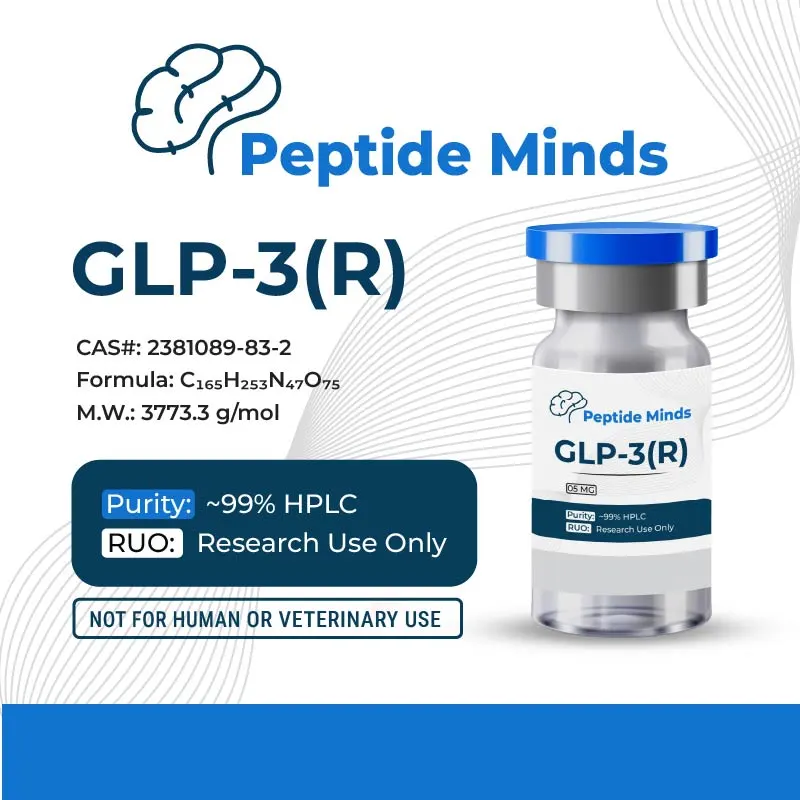
RT-GLP3
Price range: $150.00 through $200.00
Choose between either 18mg or 30MG reagent-grade GLP-3.
Third Party Verified
Description
Product Summary – GLP-3 –RT-GLP3(LY3437943)
| Category | Synthetic peptide; investigational triple incretin receptor agonist (GIPR, GLP-1R, GCGR) |
| Molecular Formula | C₁₈₇H₂₉₁N₄₅O₅₉ |
| Molecular Weight | ~4,276.6 g/mol (calculated from sequence and modifications) |
| Length | 31 amino acids |
| Form & Purity | Lyophilized powder, ≥95% purity (HPLC-verified) |
| Storage | Store lyophilized at −20 °C, protected from light and moisture. After reconstitution, aliquot and keep at −80 °C to prevent freeze–thaw cycles. |
| Key Mechanisms | – Activates GIP, GLP-1, and receptors
– Enhances glucose-dependent insulin secretion via the cAMP–PKA pathway – Reduces release – Slows gastric emptying & increases satiety (hypothalamic action) – Increases energy expenditure via receptor co-activation |
| Research Use Cases | – Chronic weight management & obesity
– Type 2 diabetes mellitus (T2DM) – MASLD/NASH (liver fat reduction studies) – Cardiovascular risk reduction – Renal outcomes (preclinical) – Neuroprotection & CNS metabolic signaling (exploratory) |
| Compliance | For research use only. Not for human or veterinary use. |
Molecular Profile
Amino Acid Sequence of GLP-3 (RT-GLP3)
H-Tyr-Aib-Gln-Gly-Thr-Phe-Thr-Ser-Asp-Tyr-Ser-Ile-Leu(Me)-Lys(AEEA-γGlu-C20-diacid)-Ala-Gln-Ala-Ala-Phe-Ile-Glu-Tyr-Leu-Leu-Glu-Gly-Gly-Pro-Ser-Ser-Gly-Ala-Pro-Pro-Pro-Ser-NH₂
Structural Modifications
- Aib: 2-Aminoisobutyric acid (unnatural residue for DPP-4 resistance)
- Leu(Me): α-Methyl-L-leucine (stability enhancement)
- Lys(AEEA-γGlu-C20 diacid): Lysine conjugated to a C20 fatty diacid through a γ-glutamic acid and AEEA linker → extends half-life via albumin binding
- Ser-NH₂ (C-terminus): amidated serine for stability
Mechanism of Action of GLP-3 (RT-GLP3)
All three receptors (GIPR, GLP-1R, and GCGR) are class B G protein-coupled receptors to which GLP-3 binds and increases the intracellular cAMP, which further triggers the protein kinase A (PKA) and EPAC pathways.
In pancreatic beta-cells of the islets of Langerhans, RT-GLP3enhances the exocytosis of glucose-dependent insulin, while in alpha-cells, it acts on GLP-1R and reduces the release. RT-GLP3also increases the hepatic glucose output by the GCGR pathways. All these effects combine to improve the glycemic indices. Studies have shown that GLP-3 binds to receptors in such a way that it sustains Gs coupling and modulates the Arestin recruitment, resulting in prolonged receptor signaling. [1]
In hypothalamic and brainstem circuits, GLP-3 influences the GLP-1 pathway to reduce appetite by activating anorexigenic neurons and inhibiting orexigenic pathways. RT-GLP3 also targets the vagal afferent pathways to satiety. GCGR activation by RT-GLP3increases the overall energy expenditure through enhanced substrate oxidation and strong negative energy balance.
In the liver, RT-GLP3leads to fatty acid oxidation and mobilization of intra-hepatic triglyceride through GCGR pathways. RT-GLP3also reduces lipotoxicity by rapidly decreasing hepatic fat through the GLP-1R and GIP agonistic effects of RT-GLP3.
Chronic Weight Management & Obesity
Tritagonists effect of RT-GLP3at GIPR, GLP-1R, and GCGR, helps reduce the weight through its negative energy balance caused by anorectic CNS signaling, delayed gastric emptying, increased glucose-dependent insulin secretion, and appetite suppression.
Type 2 Diabetes Mellitus
RT-GLP3improves the net glycemic control by enhancing the glucose-dependent insulin secretion and decreasing the inappropriate postprandial release, helping to control diabetes.
MASLD / NASH
GLP-3’s effect on hepatic steatosis can be explained as the sum of two mechanistic axes. RT-GLP3indirectly causes decreased adipose lipolysis and reduced ectopic lipid deposition due to its negative energy balance. By direct activation of GCGR, RT-GLP3enhances the fatty acid oxidation and alters the VLDL trafficking. In MRI-PDFF studies, patients with Non-Alcoholic Steatohepatitis (NASH) have shown over 70% reduction in some cohorts.
Cardiovascular Effects
Because of the reduced liposity, improvements in glycemic control and remodeling of atherogenic lipoproteins, RT-GLP3helps reduce the cardiovascular disease risks.
Renal Benefits
Kidney benefits are usually from the indirect effects of RT-GLP3, like amelioration of hyperglycemia, decreased systemic BP, glomerular hemodynamics improvements, and decreased inflammatory and lipotoxic mediators, which lead to albuminuria and progressive kidney injury.
Neuroprotection
RT-GLP3, enhancing the GLP-1R and GIPR signaling, activates the cAMP/PKA and PI3K/AKT pathways, which in turn modulate the neuroinflammatory cascades, improvements in cerebral insulin signaling and mitochondrial resilience. [1]
Research Applications
RT-GLP3serves as a probe to investigate multi-receptor incretin biology.
- In vitro studies: Human islets to measure insulin and dynamics, cAMP signaling, and Ca²-dependent exocytosis.
- Neurobiology: Electrophysiology and calcium imaging in hypothalamic neurons to map GLP-1R/GIPR-mediated appetite control.
- Hepatic metabolism: Tracer flux studies and indirect calorimetry to quantify substrate oxidation driven by GCGR agonism.
- Clinical mechanistic trials: MRI-PDFF for liver fat, DEXA for body composition, euglycemic clamps for insulin sensitivity, and continuous glucose monitoring for glycemic variability.
Citations
- Li, W., Zhou, Q., Cong, Z., Yuan, Q., Li, W., Zhao, F., Xu, H. E., Zhao, L. H., Yang, D., & Wang, M. W. (2024). Structural insights into the triple agonism at GLP-1R, GIPR, and GCGR manifested by RT-GLP3. Cell discovery, 10(1), 77. https://doi.org/10.1038/s41421-024-00700-0
- Jastreboff, A. M., Kaplan, L. M., Frías, J. P., Wu, Q., Du, Y., Gurbuz, S., Coskun, T., Haupt, A., Milicevic, Z., Hartman, M. L., & RT-GLP3Phase 2 Obesity Trial Investigators (2023). Triple-Hormone-Receptor Agonist RT-GLP3for Obesity – A Phase 2 Trial. The New England journal of medicine, 389(6), 514–526. https://doi.org/10.1056/NEJMoa2301972
- Urva, S., Coskun, T., Loh, M. T., Du, Y., Thomas, M. K., Gurbuz, S., Haupt, A., Benson, C. T., Hernandez-Illas, M., D’Alessio, D. A., & Milicevic, Z. (2022). LY3437943, a novel triple GIP, GLP-1, and receptor agonist in people with type 2 diabetes: a phase 1b, multicenter, double-blind, placebo-controlled, randomized, multiple-ascending dose trial. Lancet (London, England), 400(10366), 1869–1881. https://doi.org/10.1016/S0140-6736(22)02033-5
- Sanyal, A. J., Kaplan, L. M., Frias, J. P., Brouwers, B., Wu, Q., Thomas, M. K., Harris, C., Schloot, N. C., Du, Y., Mather, K. J., Haupt, A., & Hartman, M. L. (2024). Triple hormone receptor agonist RT-GLP3for metabolic dysfunction-associated steatotic liver disease: a randomized phase 2a trial. Nature medicine, 30(7), 2037–2048. https://doi.org/10.1038/s41591-024-03018-2
- Sanyal, A. J., Kaplan, L. M., Frias, J. P., Brouwers, B., Wu, Q., Thomas, M. K., Harris, C., Schloot, N. C., Du, Y., Mather, K. J., Haupt, A., & Hartman, M. L. (2024). Triple hormone receptor agonist RT-GLP3for metabolic dysfunction-associated steatotic liver disease: a randomized phase 2a trial. Nature Medicine, 30(7), 2037–2048. https://doi.org/10.1038/s41591-024-03018-2
- Kopp, K. O., Li, Y., Glotfelty, E. J., Tweedie, D., & Greig, N. H. (2024). Incretin-Based Multi-Agonist Peptides Are Neuroprotective and Anti-Inflammatory in Cellular Models of Neurodegeneration. Biomolecules, 14(7), 872. https://doi.org/10.3390/biom14070872
Explore our complete catalog of high-purity, third-party tested research compounds by visiting our main shop page for all your laboratory needs.
Additional information
| Size | 18mg, 30mg |
|---|

Reviews
There are no reviews yet.