

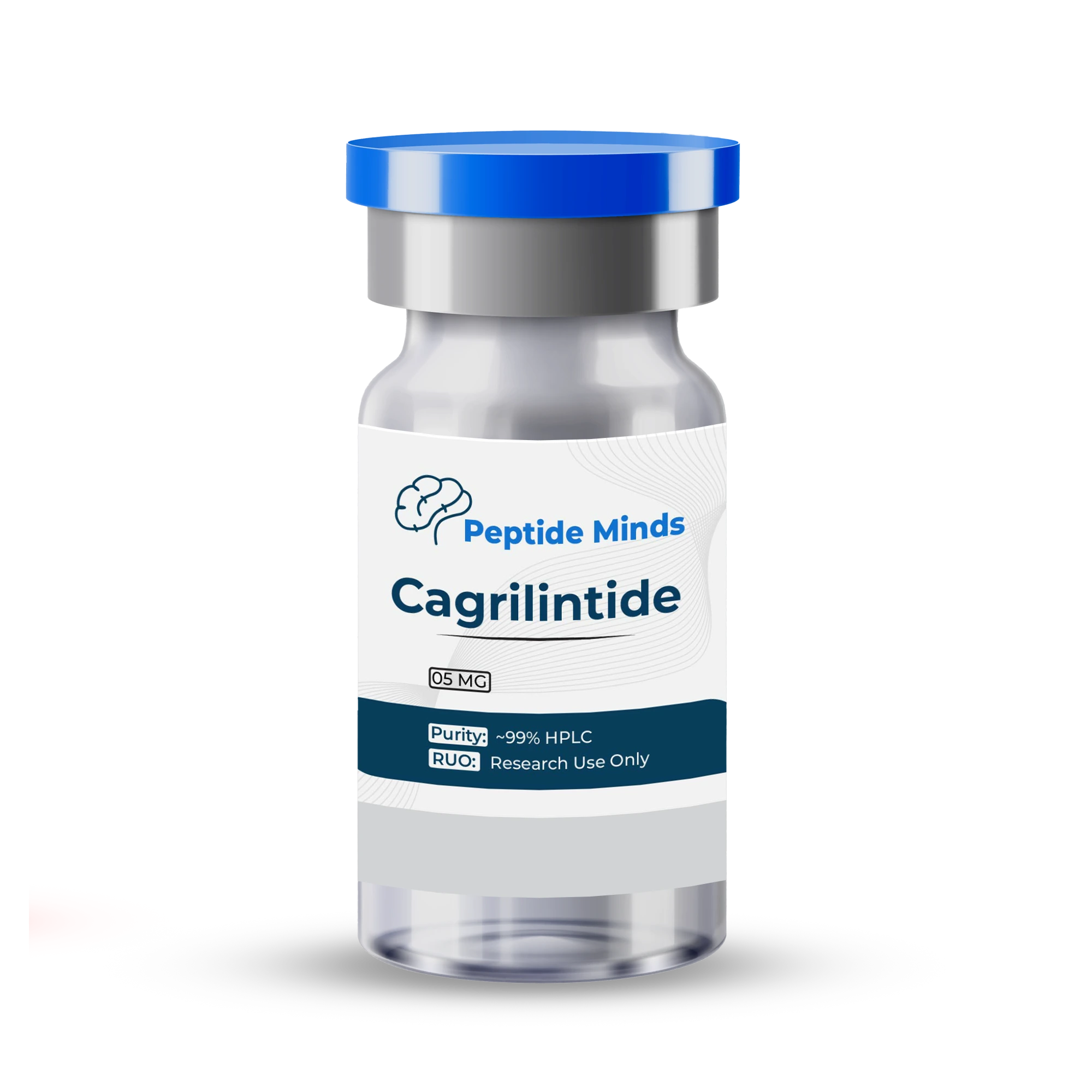
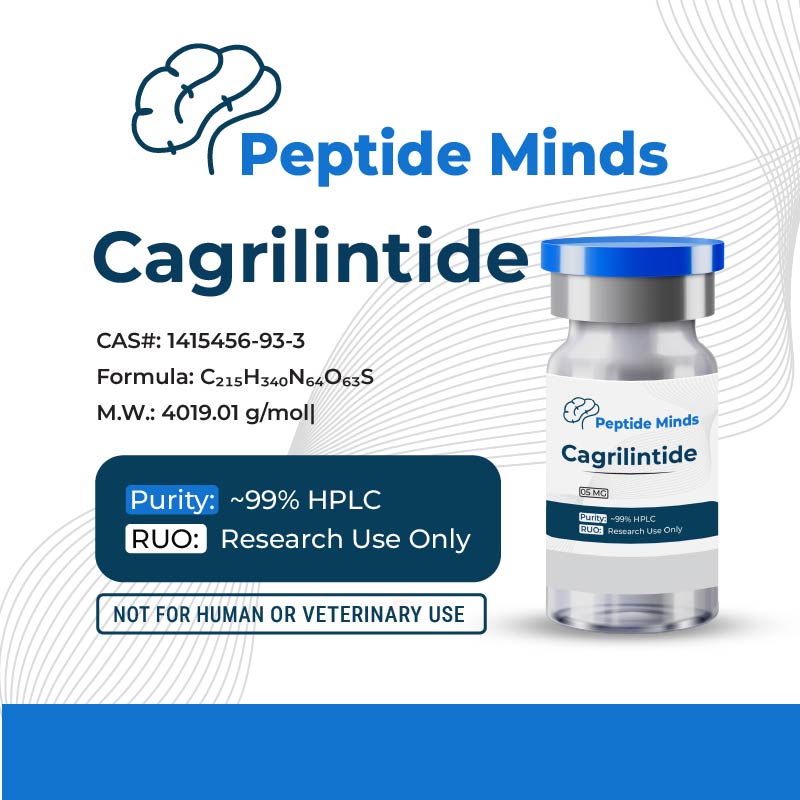
Cagrilintide
$110.00
5mg of reagent-grade Cagrilintide.
Third Party Verified
Description
Product Summary – Cagrilintide – Amylin Receptor Agonist
| Field | Details |
| Product Name | Cagrilintide (AM833) |
| Category | Synthetic peptide; long-acting acylated amylin analogue; non-selective amylin (AMY) receptor agonist |
| Molecular Formula | C₁₉₄H₃₁₂N₅₄O₅₉S₂ |
| Molecular Weight | ~4,409 g/mol |
| Length | 39 amino acids |
| Form & Purity | Lyophilized powder, ≥95% purity (HPLC-verified) |
| Storage | Store lyophilized at −20 °C, protected from light and moisture. After reconstitution, aliquot and keep at −80 °C to prevent freeze–thaw cycles |
| Key Mechanisms | – Agonizes AMY receptors → enhances satiety & reduces food intake
– Slows gastric emptying & reduces post-prandial glucagon rise – Long-acting via albumin-binding lipidation – Additive weight-loss effect with GLP-1R agonists (e.g., semaglutide) |
| Research Use Cases | – Chronic weight management & obesity (mono and combo)
– Type 2 diabetes adjunct therapy – Energy balance & fat-mass reduction – MASLD/NASH (exploratory) – Receptor pharmacology & structural biology studies |
| Common AEs | – GI events (nausea, vomiting), mostly mild–moderate
– Vomiting rates appear lower vs GLP-1 RAs in comparative syntheses – AE profile is similar when co-administered with semaglutide |
| Compliance | For research use only. Not for human or veterinary use. |
Molecular Profile
Amino Acid Sequence of Cagrilintide
{Eicosanedioic-acid-γ-Glu}-Lys-Cys-Asn-Thr-Ala-Thr-Cys-Ala-Thr-Gln-Arg-Leu-Ala-Glu-Phe-Leu-Arg-His-Ser-Ser-Asn-Asn-Phe-Gly-Pro-Ile-Leu-Pro-Pro-Thr-Asn-Val-Gly-Ser-Asn-Thr-Pro-NH2 (Disulfide bridge:Cys3-Cys8)
Structural Modifications of Cagrilintide
- Proline substitutions: Pro25, Pro28, Pro29 reduce amyloid fibril formation; additional stabilizers reported (Asn14→Glu, Val17→Arg, Tyr37→Pro).
- Acylation chemistry: N-terminally acylated with C20 diacid (eicosanedioic acid) via a γ-Glu spacer → promotes albumin binding & long half-life.
- Spacer notes: Some sources list AEEA linkers, but the canonical construct is γ-Glu–C20 diacid.
- N-terminal Lysine: Present but acylated with γ-Glu–C20.
- C-terminal amidation: Enhances stability & receptor activity. (NovoPro)
Half-life of Cagrilintide
Based on phase 1 and phase 2 clinical pharmacology studies in humans, its elimination half-life is approximately 159 to 195 hours (≈ 7–8 days). [1]
Mechanism of Action of Cagrilintide
Cagrilintide binds and influences the pathways of calcitonin receptors (CTR) and amylin receptors (AMY1, AMY2 & AMY3) through GPCRs. This Gs-biased activation leads to increased intracellular cAMP, which in turn enhances the PKA/EPAC pathways. [2]
Cagrilintide activates the amylin receptors, which are densely present in the area postrema and the nucleus of the solitary tract (NTS) of the hindbrain, leading to increased satiety and reduced meal size. In addition to this, cagrilintide also increases the anorectic effect by enhancing the melanocortin signalling to the paraventricular nucleus (PVN) through the pro-opiomelanocortin (POMC) neurons in the arcuate nucleus. Cagrilintide improves the postprandial glycemic control by suppressing the secretion of postprandial glucagon. [3]
Investigational / Clinical Trial Use
Chronic Weight Management & Obesity
Cagrilintide helps reduce weight by sustained activation of amylin receptors in the hindbrain and hypothalamus circuit. In phase 2 and phase 3 programs, once weekly caglintide monotherapy was found to cause weight loss. When it was coadministered with semaglutide (CagriSema), it led to substantial weight reduction because of its synergistic anorectic effects.
Type 2 Diabetes Mellitus
Cagrilintide improves the postprandial glycemic control through its direct and indirect effects. Weight loss due to cagrlinitide leads to reduced caloric intake and ultimately insulin resistance. The drug also decreases hepatic glucose release and slows down the gastric emptying to reduce the postprandial glucose levels. [5]
MASLD/NASH
By reducing weight and insulin resistance, cagrilintide decreases hepatic steatosis and related metabolic inflammation. Direct clinical trials data for cagrilintide in MASLD/NASH are still exploratory.
Tolerability and Safety Considerations
- GI events are most pronounced during initiation; a stepwise titration (0.25 mg → 0.5 mg → 1.0 mg → 1.7 mg → 2.4 mg weekly) improves tolerability.
- Combination therapy (CagriSema: cagrilintide + semaglutide) may increase GI adverse events, but these remain manageable with careful dose escalation.
- No evidence of hepatotoxicity, nephrotoxicity, or cardiovascular risk in current data.
Citations
- Enebo, L. B., Berthelsen, K. K., Kankam, M., Lund, M. T., Rubino, D. M., Satylganova, A., & Lau, D. C. W. (2021). Safety, tolerability, pharmacokinetics, and pharmacodynamics of concomitant administration of multiple doses of cagrilintide with semaglutide 2·4 mg for weight management: a randomised, controlled, phase 1b trial. Lancet (London, England), 397(10286), 1736–1748. https://doi.org/10.1016/S0140-6736(21)00845-X
- Cao, J., Belousoff, M. J., Johnson, R. M., Keov, P., Mariam, Z., Deganutti, G., Christopoulos, G., Hick, C. A., Reedtz-Runge, S., Glendorf, T., Ballarín-González, B., Raun, K., Bayly-Jones, C., Wootten, D., & Sexton, P. M. (2025). Structural and dynamic features of cagrilintide binding to calcitonin and amylin receptors. Nature communications, 16(1), 3389. https://doi.org/10.1038/s41467-025-58680-y
- Lutz, T. A., Coester, B., Whiting, L., Dunn-Meynell, A. A., Boyle, C. N., Bouret, S. G., Levin, B. E., & Foll, C. L. (2018). Amylin Selectively Signals Onto POMC Neurons in the Arcuate Nucleus of the Hypothalamus. Diabetes, 67(5), 805. https://doi.org/10.2337/db17-1347
- Lau, D. C. W., Erichsen, L., Francisco, A. M., Satylganova, A., Le Roux, C. W., McGowan, B., Pedersen, S. D., Pietiläinen, K. H., Rubino, D., & Batterham, R. L. (2021). Once-weekly cagrilintide for weight management in people with overweight and obesity: a multicentre, randomised, double-blind, placebo-controlled and active-controlled, dose-finding phase 2 trial. Lancet (London, England), 398(10317), 2160–2172. https://doi.org/10.1016/S0140-6736(21)01751-7
- Frias, J. P., Deenadayalan, S., Erichsen, L., Knop, F. K., Lingvay, I., Macura, S., Mathieu, C., Pedersen, S. D., & Davies, M. (2023). Efficacy and safety of co-administered once-weekly cagrilintide 2·4 mg with once-weekly semaglutide 2·4 mg in type 2 diabetes: a multicentre, randomised, double-blind, active-controlled, phase 2 trial. Lancet (London, England), 402(10403), 720–730. https://doi.org/10.1016/S0140-6736(23)01163-7
Additional information
| Size | 5MG, 10MG |
|---|---|
| Quantity | 1 VIAL, 2 VIALS, 5 VIALS, 10 VIALS |
Reviews
There are no reviews yet.