
Understanding the Challenges and Regulations of Neoantigen Peptide Cancer Vaccines
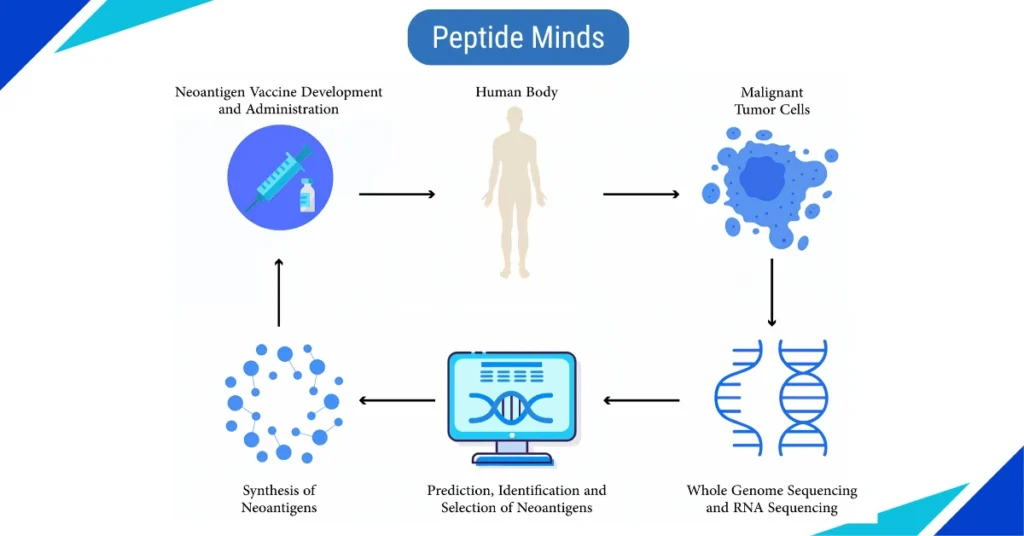
Neoantigen peptide cancer vaccines have emerged as a promising and innovative approach in personalized cancer immunotherapy. These vaccines aim to target unique antigens presented by tumor cells, stimulating the immune system to recognize and attack cancer. The concept of using neoantigens mutated proteins found only in cancer cells has revolutionized the approach to cancer treatment, offering the potential for tailored therapies. However, the development and deployment of neoantigen peptide vaccines face significant challenges, from scientific hurdles in neoantigen identification and synthesis to complex regulatory requirements that vary across regions.
At Peptide Minds, we are committed to advancing the future of personalized medicine. You can explore our range of high-quality peptide products on our Shop , which includes Cagrilintide a peptide designed for clinical applications and therapeutic use in research. Additionally, our Peptide Mind product offers a highly purified peptide sequence for targeted studies, aiding advancements in cancer research and beyond.
We will delve into the challenges of neoantigen peptide cancer vaccines, focusing on the scientific, manufacturing, and clinical issues that arise. We will also explore the regulatory landscape that governs the development of these vaccines, including the hurdles posed by lack of standardized guidelines, ethical considerations, and the difficulties in adhering to stringent manufacturing protocols. The article concludes by looking at the future directions and the potential for overcoming these barrier.
Scientific and Manufacturing Challenges
The development of neoantigen peptide vaccines faces significant scientific challenges, particularly in the accurate identification and validation of tumor-specific neoantigens. Additionally, manufacturing these vaccines on a personalized scale presents hurdles in peptide synthesis, purity, and ensuring consistent production under stringent Good Manufacturing Practice (GMP) standards.
Lack of Standardized Guidelines
The regulatory landscape for neoantigen peptide vaccines is still evolving. With the technology being relatively new, there are no clear, internationally standardized guidelines, which leads to inconsistent approval processes across different regions. This lack of uniformity complicates the path to market.
Chemistry, Manufacturing, and Controls (CMC) Issues
Regulatory authorities require detailed data on the chemistry, manufacturing, and controls of vaccines to ensure product quality. For neoantigen vaccines, ensuring consistency across batches is a challenge, as each vaccine is tailored to an individual patient, creating difficulties in meeting regulatory demands for batch consistency.
Ethical and Logistical Concerns
Neoantigen peptide vaccines involve a highly personalized treatment process, which raises ethical issues related to patient consent, data privacy, and the logistics of tumor sample collection. Managing these concerns is essential for the success of clinical trials and eventual commercial production.
Clinical and Therapeutic Considerations
Immune-Related Adverse Events (irAEs)
As with other forms of immunotherapy, neoantigen peptide vaccines can cause immune-related adverse events. These side effects can range from mild to severe, necessitating careful monitoring and management to ensure patient safety.
Challenges with Tumor Microenvironment
The tumor microenvironment is often immunosuppressive, making it difficult for vaccines to be fully effective. Research is underway to find ways to overcome these immunosuppressive barriers, enhancing the efficacy of neoantigen vaccines.
Future Directions
- Improved Predictive Algorithms
Advancements in machine learning and computational modeling could lead to more accurate predictions of potential neoantigens, improving vaccine design and effectiveness. - Standardization of Manufacturing Processes
Establishing standardized production protocols will be key to making personalized vaccines more scalable and accessible to a larger patient population. - Global Regulatory Harmonization
Efforts to standardize regulatory processes globally will streamline the approval of neoantigen vaccines, making them more accessible to patients worldwide.
Conclusion
While neoantigen peptide vaccines offer a groundbreaking approach to personalized cancer treatment, overcoming the scientific, manufacturing, and regulatory challenges remains a significant barrier. Continued research, improved manufacturing practices, and regulatory harmonization will be essential for the successful development and widespread use of these vaccines.
Frequently Asked Questions (FAQs)
References
Xie, N., et al. (2023). Neoantigens: promising targets for cancer therapy. Signal Transduction and Targeted Therapy. https://doi.org/10.1038/s41392-022-01270-x
Li, X., et al. (2023). Neoantigen cancer vaccines: a new star on the horizon. Cancer Biology & Medicine. https://doi.org/10.20892/j.issn.2095-3941.2023.0395
Katsikis, P. D. (2023). Challenges in developing personalized neoantigen cancer vaccines. Frontiers in Immunology. https://doi.org/10.3389/fimmu.2023.12001822
Singh, P., et al. (2025). Advancements and challenges in personalized neoantigen-based cancer vaccines. Frontiers in Oncology. https://doi.org/10.3389/or.2025.1541326
Li, D., et al. (2024). Advances and challenges in peptide-based cancer vaccination: A review. Frontiers in Immunology. https://doi.org/10.3389/fimmu.2024.11359700
Fan, T., et al. (2023). Therapeutic cancer vaccines: advancements, challenges, and future perspectives. Signal Transduction and Targeted Therapy. https://doi.org/10.1038/s41392-023-01674-3
Chen, I., et al. (2021). Challenges targeting cancer neoantigens in 2021. Frontiers in Immunology. https://doi.org/10.3389/fimmu.2021.8410655
Shemesh, C. S., et al. (2020). Personalized cancer vaccines: Clinical landscape and future directions. Frontiers in Immunology. https://doi.org/10.3389/fimmu.2020.7854282
Chakraborty, C., et al. (2024). The landscape of neoantigens and its clinical applications. Frontiers in Oncology. https://doi.org/10.3389/fonc.2024.25902628
Manoutcharian, K., et al. (2024). Are we getting closer to a successful neoantigen cancer vaccine? Cell Reports Medicine. https://doi.org/10.1016/j.xcrm.2024.100013