
The Impact of Counter-ions in Peptides: Implications for Research in Various Fields
Counter-ions play a crucial yet often overlooked role in peptide research, influencing everything from solubility to biological activity. Imagine you’re working with a synthetic peptide in the lab say a hormone‑like molecule, an antimicrobial peptide, or a targeted therapeutic. You treat it like the “active component” of your experiment, but there’s an often‑ignored partner lurking in the vial: the counter‑ion. That small companion can quietly affect your results. In this article, we’ll walk together through what a counter‑ion is in the context of peptides, why it matters across research fields, how it influences results in practice, and what you (as a researcher or doctor) should keep in mind.
To further explore the fascinating world of peptides and their various applications in scientific research, we invite you to visit our home page. At Peptide Minds, we provide in-depth resources and insights into peptide synthesis, drug discovery, and therapeutic innovations. Whether you’re a researcher or healthcare professional, our platform offers valuable information and cutting-edge research to help you stay ahead in the field of peptide science. Explore more about peptide studies, including the impact of counter-ions, and discover how Peptide Minds can support your research journey.
What is a counter‑ion in peptide chemistry?
Here are a few reasons to care:
Regulatory, formulation and translational implications
In the therapeutic peptide space, the choice of counter‑ion is not trivial. A recent study comparing TFA vs HCl salt form of a peptide hydrogel found that even though “intended use” properties were similar, regulatory and formulation aspects (e.g., removal of TFA, toxicity concerns) mattered.
Physicochemical properties
The salt form whether a peptide is a TFA salt, HCl salt, acetate salt, etc. can change its aqueous solubility, hydrophobicity, aggregation tendency, secondary structure. For example, one study found that peptides in TFA salt form may hamper structural studies because the TFA counter‑ions affect absorption spectra.
Biological and functional activity
The counter‑ion may modify how the peptide interacts with cells or membranes. In antimicrobial peptide studies, researchers reported that different salt forms (acetate, hydrochloride, trifluoroacetate) of the same peptide showed different antimicrobial activity and cytotoxicity.
Interpretation of data & reproducibility
If you compare studies that used different salt forms of the same peptide (e.g., TFA vs HCl), subtle differences in results may actually reflect the counter‑ion effect rather than peptide sequence differences. This complicates meta‐analysis, translational work, and clinical interpretation.
How counter‐ions influence different fields of study
Let’s look at several fields and how counter‑ions can matter in each.
Antimicrobial/peptide drug discovery
In studies of antimicrobial peptides (AMPs), you might think only the peptide sequence and charge matter. But counter‑ion can modulate outcomes. One study found that for peptides like CAMEL, citropin 1.1, LL‑37, pexiganan and temporin A, the type of counter‑ion influenced the antistaphylococcal activity and cytotoxicity.
For example, the order of effectiveness changed with salt form; the selectivity index (antibacterial versus hemolysis) was highest for CAMEL hydrochloride, pexiganan acetate, temporin A TFA‑salt. That means: your “best” peptide might appear different if you changed the salt.
Structural/biophysical peptide studies
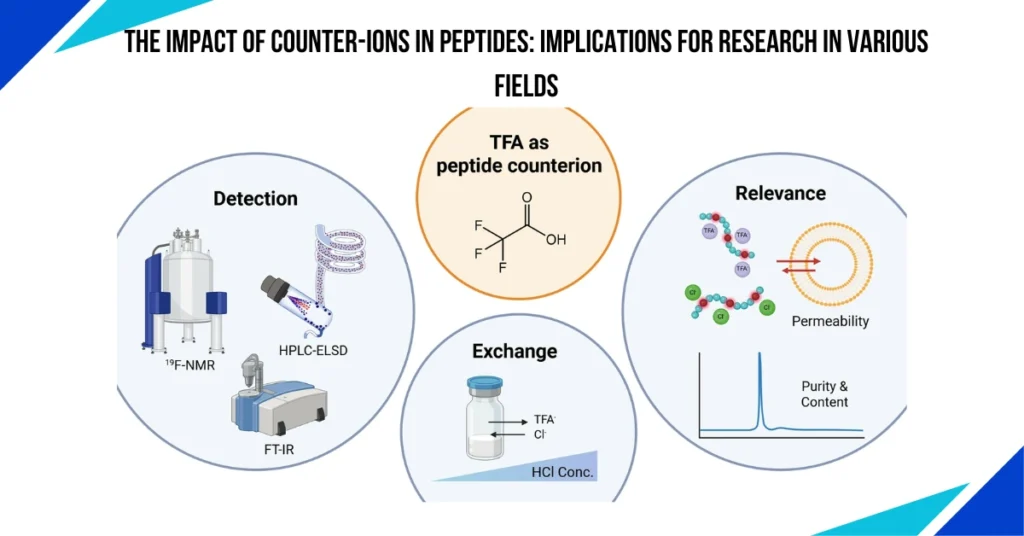
When investigating peptide folding, membrane interactions, aggregation, spectroscopy, etc., the presence of counter‑ions can interfere. For example: the TFA counter‐ion might affect the spectrum absorption and hence the interpretation of a CD or FTIR experiment.
Also, a recent systematic study pointed out that removal of TFA and exchange to chloride (Cl⁻) altered the peptide’s membrane permeability coefficients, depending on sequence.
Drug formulation and delivery
In therapeutics, peptides may be delivered via hydrogels, nanoparticles, injection, or oral routes. The salt form affects stability, release kinetics, solubility, and even toxicity. The 2025 study comparing TFA vs HCl salt of a peptide hydrogel found interesting observations.
Moreover, hydrophobic ion pairing (HIP) approaches for improving oral delivery of peptides rely on counter‐ions (e.g., hydrophobic anions) to form lipophilic ion pairs with peptides, altering their absorption.
Clinical/translational research
As a clinician‐researcher you may not always think about which salt form the peptide came in. But if a preclinical peptide showed activity in vitro and you plan translation, the counter‐ion could affect safety (cytotoxicity, immunogenicity), pharmacokinetics, biodistribution. For instance, residual TFA from peptide synthesis has been shown to affect cell growth at low concentrations in cell culture.
Thus, your translational roadmap must include considerations of the peptide salt form and whether counter‑ion exchange is needed.
Key practical considerations and best practices
Here are practical points you and your team should apply:
Be careful in cell‐based assays: residual counter‑ion (especially TFA) may itself have biological activity (e.g., via peroxisome proliferation in animal cells) and confound results.
Always report the peptide salt form (e.g., TFA salt, HCl salt, acetate) in your methods section. For reproducibility.
If you compare different peptides or different studies, ask: are they different because sequence is different or because salt/form is different?
If using a peptide for functional assays, consider exchanging to a “safer” or more physiologically relevant counter‑ion (e.g., HCl or acetate) rather than TFA. Many authors recommend this.
For structural/biophysical work: check if counter‑ion influences spectra (CD, NMR, FTIR), and consider effects of residual counter‐ions on folding/aggregation.
For formulation/delivery: evaluate the salt form’s impact on solubility, stability, release kinetics, toxicity and regulatory acceptability.
If dealing with clinical translation: ensure removal or minimisation of undesirable counter‑ions (e.g., residual TFA) and conduct appropriate analytics (NMR, FT‑IR, ELSD) to quantify counter‑ion content.
Limitations and open questions
- While many studies show counter‑ion matters, patterns are not always consistent; for some peptides the effect is minimal. For example, one study of lipopeptides found no significant effect of TFA counter‐ion on antimicrobial activity.
- Quantifying residual counter‑ions in peptide samples is not always standardised; different labs have different exchange/removal efficiencies.
- Translational relevance: in vivo effects of counter‐ion differences are less widely studied than in‐vitro.
- Sometimes it’s unclear whether observed differences originate from the counter‑ion itself, minor differences in peptide batch/purity/impurities, or peptide‐counter‑ion interaction.
Conclusion
In peptide research, the counter-ion is often an overlooked but crucial factor that can influence a wide range of outcomes, from peptide solubility and stability to biological activity and clinical efficacy. As we’ve explored, different counter-ions can significantly alter the results of experiments across various research fields, including antimicrobial studies, structural analysis, drug delivery systems, and clinical applications.
Understanding the role of counter-ions in peptide behavior is essential for ensuring reproducibility, accuracy, and translational success. By carefully selecting, documenting, and sometimes exchanging counter-ions, researchers can minimize potential confounding variables and improve the reliability of their findings. Moving forward, addressing the challenges posed by counter-ions and their impact on peptide function will be critical for advancing peptide-based therapies and achieving consistent results in both laboratory and clinical settings.
As peptide science continues to evolve, a deeper understanding of how counter-ions influence peptide behavior will pave the way for more precise, effective, and safe peptide-based treatments and drug delivery systems.
Frequently Ask Question
References
Greber K.E., et al. “Cationic Net Charge and Counter Ion Type as Lipopeptide Activity Modulators.” Frontiers in Microbiology, 2017.
Sikora K., et al. “Counter‑ion effect on antistaphylococcal activity and cytotoxicity of selected antimicrobial peptides.” Amino Acids, 2018.
S. K. “The Role of Counter‑Ions in Peptides—An Overview.” PMC, 2020.
Moore J.V. et al. “Impact of counter-ion in peptide on studies in different research fields.” GenScript Peptide News, 2019.
Erckes V., Streuli A., Chamera Rendueles L. “Towards a Consensus for the Analysis and Exchange of TFA as a Counterion in Synthetic Peptides and Its Influence on Membrane Permeation.” Pharmaceuticals, 2025.