
Peptide Libraries and Their Role in Probing SARS-CoV-2 Cross-Reactive T Cell Memory
The global fight against SARS-CoV-2 has revealed a crucial aspect of our immune system: the ability of pre-existing T cell memory to cross-react with the virus, even in individuals with no prior exposure. This phenomenon of cross-reactivity, largely due to shared epitopes between SARS-CoV-2 and common human coronaviruses, raises key questions for researchers and vaccine developers. How can we harness this knowledge to create more effective, broad-spectrum vaccines? The answer lies in peptide libraries—valuable tools that allow scientists to map these T cell responses and uncover critical insights into immune memory. In this article, we will explore the role of peptide libraries in identifying cross-reactive T cell responses, the implications for vaccine development, and how these findings may shape future immunization strategies.
If you’re interested in understanding how peptide libraries can enhance immunological research, be sure to visit Peptide Mind for comprehensive resources and solutions tailored to peptide-based studies.
The Role of Peptide Libraries in T Cell Immunology
Peptide libraries are collections of short peptide sequences derived from proteins that are used to identify and characterize T cell epitopes—the specific parts of an antigen that are recognized by T cell receptors. In the context of SARS-CoV-2, researchers have constructed extensive peptide libraries from the virus’s proteome to map T cell responses. These libraries facilitate the identification of both virus-specific and cross-reactive epitopes, providing insights into the immune system’s recognition patterns.
Cross-Reactivity Between SARS-CoV-2 and HCoVs
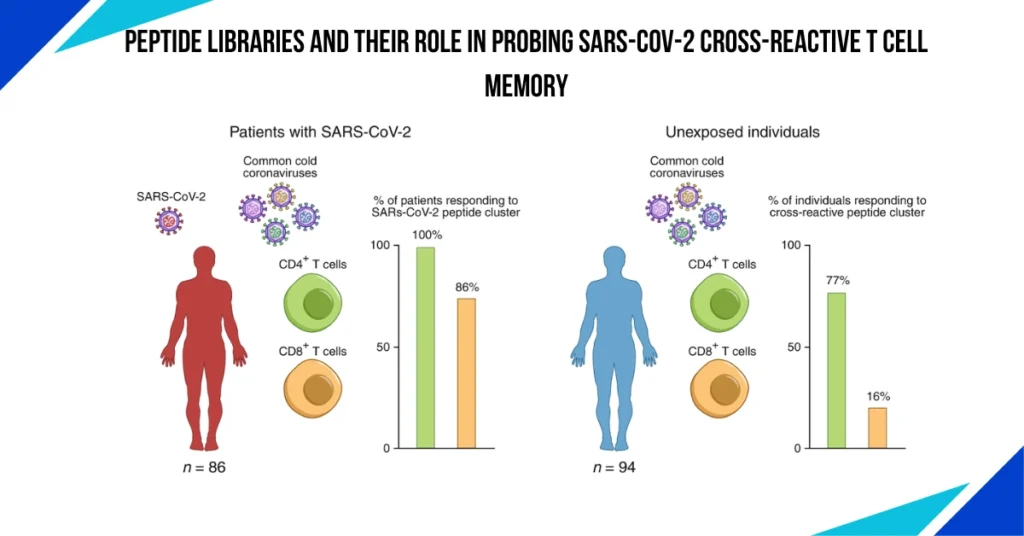
Studies have demonstrated that T cells from individuals without prior SARS-CoV-2 exposure can recognize and respond to SARS-CoV-2 peptides, particularly those derived from the spike (S) protein. This cross-reactivity is primarily due to sequence homology between SARS-CoV-2 and endemic HCoVs, such as HCoV-OC43 and HCoV-HKU1. For instance, a study by Mateus et al. (2020) identified a range of pre-existing memory CD4+ T cells that cross-react with comparable affinity to both SARS-CoV-2 and common cold coronaviruses.
Furthermore, research by Kundu et al. (2022) found that higher frequencies of cross-reactive, IL-2-secreting memory T cells were present in individuals who remained PCR-negative despite exposure to SARS-CoV-2, suggesting a protective role of these pre-existing T cells.
Implications for Vaccine Development
The identification of cross-reactive T cell responses has significant implications for vaccine design. Traditional vaccines often focus on the spike protein’s receptor-binding domain (RBD), which is prone to mutations. In contrast, incorporating epitopes from more conserved regions of the virus, such as the nucleocapsid (N) and membrane (M) proteins, can elicit broader and more durable T cell responses. For example, the UB-612 vaccine candidate includes synthetic peptides representing T cell epitopes on the S, N, and M proteins, aiming to provide comprehensive immunity against SARS-CoV-2 variants
Long-Term Immunological Memory
Cross-reactive T cells not only contribute to initial immune responses but also play a role in long-term immunity. Studies have shown that these T cells persist over time and can respond to subsequent exposures to SARS-CoV-2 or related coronaviruses. For instance, Florian et al. (2025) observed that pre-existing T cells reactive to the seasonal coronavirus OC43 cross-reacted with the SARS-CoV-2 spike peptide S813-829, and their frequency increased following infection or vaccination, correlating with enhanced immunity against Omicron variants.
Implications for Immunotherapy
Understanding how it modulates the immunopeptidome has significant implications for immunotherapy. By manipulating proteasomal activity and composition, it is possible to enhance the presentation of tumor-specific peptides, thereby improving the efficacy of T cell-based therapies. For example, pharmacological activation of the immunoproteasome has been shown to increase the diversity and abundance of MHC class I-bound peptides, leading to enhanced recognition and elimination of tumor cells by cytotoxic T lymphocytes
Conclusion
Peptide libraries have been instrumental in uncovering the complexities of T cell memory and cross-reactivity in the context of SARS-CoV-2. The insights gained from these studies are crucial for developing vaccines that elicit broad and lasting immune responses, potentially offering protection against current and future coronavirus strains. Continued research in this area will enhance our understanding of T cell immunity and inform the development of more effective immunization strategies.
For researchers and professionals looking to advance their studies in immunology and related fields, Peptide Mind offers a comprehensive selection of high-quality peptides designed to support your experiments and discoveries. Whether you’re working on vaccine development, T cell mapping, or other peptide-based studies, our shop provides reliable and premium products tailored to meet the needs of your research. Explore our offerings and take your work to the next level with Peptide Mind’s carefully curated collection. Visit Peptide Mind’s shop today to find the peptides you need for your next breakthrough.
Frequently Ask Question
References
- Mateus, J., et al. (2020). “Selective and cross-reactive SARS-CoV-2 T cell epitopes in unexposed individuals.” Science, 370(6512), 89-93. Link
- Kundu, R., et al. (2022). “Cross-reactive memory T cells associate with protection against SARS-CoV-2 infection in COVID-19 contacts.” Nature Communications, 13(1), 1-10. Link
- Florian, D. M., et al. (2025). “Enhanced and long-lasting SARS-CoV-2 immune memory induced by cross-reactive T cells.” Frontiers in Immunology, 16, 1501704. Link
- UB-612 COVID-19 Vaccine Candidate. (2022). “UB-612: A peptide-based COVID-19 vaccine.” Link
- Sette, A., et al. (2020). “The role of T cell immunity in COVID-19.” Nature Reviews Immunology, 20(11), 1-2. Link