
COA vs SDS is a common comparison researchers make when understanding product quality and laboratory safety documentation. In the realm of scientific research, pharmaceuticals, and chemical industries, professionals like doctors, researchers, and laboratory technicians rely on two crucial documents Certificates of Analysis (COA) and Safety Data Sheets (SDS).
These documents play vital roles in ensuring safety, accuracy, and compliance with industry standards. However, understanding the differences between them is essential for correct usage, minimizing risks, and ensuring quality control in every scientific experiment and product application. Let’s explore how these two documents function, their differences, and how they impact your work in healthcare, research, and pharmaceuticals. Additionally, if you are looking for top-quality peptides for research, check out our Peptide Minds for premium peptides like Mazdutide and Reconsitution Solution.
What is a Certificate of Analysis (COA)?
A Certificate of Analysis (COA) is a vital document provided by the manufacturer or supplier that confirms a product’s quality and compliance with its specifications. For pharmaceutical products, chemicals, and raw materials, COAs detail the results of rigorous tests that have been conducted to verify the product’s purity, potency, chemical composition, and physical properties. This ensures that the substance or chemical is fit for its intended purpose and meets all regulatory and industry standards. A COA is typically issued with every batch of product and serves as a form of quality control for professionals relying on these substances for research or treatment purposes.
For example, a COA for a peptide-based product may include information about the purity of the peptide, the concentration of active ingredients, and the results of specific tests such as HPLC (High-Performance Liquid Chromatography) or Mass Spectrometry. These results ensure that the product is safe, effective, and free from contaminants, which is especially important in medical research and patient care.
What is a Safety Data Sheet (SDS)?
A Safety Data Sheet (SDS) is a comprehensive document that provides detailed information about a chemical substance or mixture’s hazards, handling instructions, storage guidelines, and emergency response procedures. An SDS is required by law and is designed to inform workers, researchers, and healthcare professionals about the potential risks associated with the use of a chemical. It includes data on toxicity, flammability, reactivity, and environmental impact, as well as recommended personal protective equipment (PPE) and first aid measures in case of exposure.
An SDS typically consists of several sections, including the product’s identification, hazard classification, first-aid measures, handling and storage recommendations, and information on disposal and transport. It’s a crucial resource for professionals working with hazardous chemicals, ensuring that proper safety protocols are followed at all times.
Certificates of Analysis versus Safety Data Sheets (COA vs SDS)
COA vs SDS Key Differences
If COA vs SDS is addressed, both COA and SDS are essential documents, they serve very different purposes:
- Purpose:
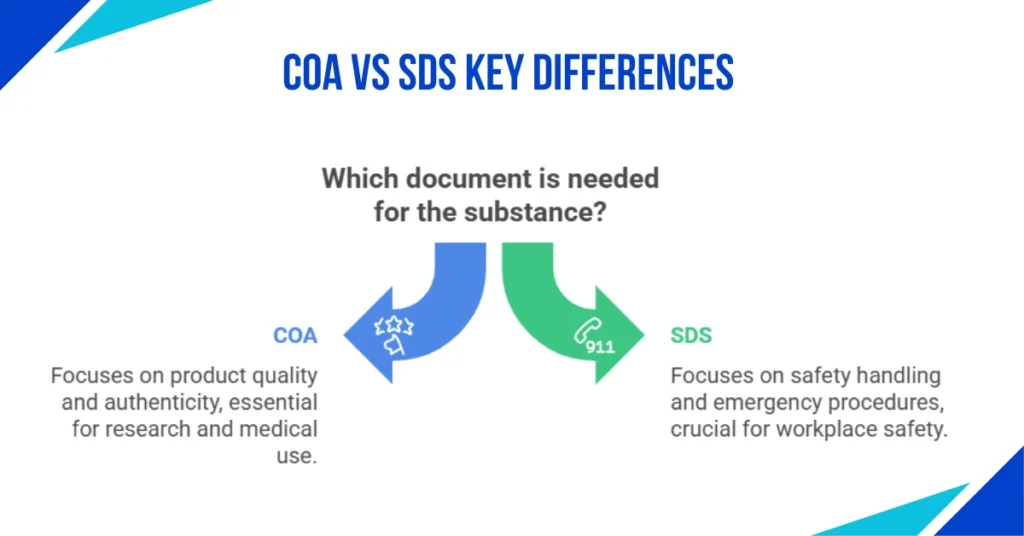
- A COA focuses on the product’s quality, verifying that it meets the required standards and specifications. It serves as proof of the substance’s authenticity and potency.
- An SDS, on the other hand, focuses on the safety of handling, storing, and disposing of the substance. It provides comprehensive safety and emergency information to prevent accidents or harm.
- A COA focuses on the product’s quality, verifying that it meets the required standards and specifications. It serves as proof of the substance’s authenticity and potency.
- Content:
- A COA typically includes data such as test results for purity, chemical composition, and batch-specific information.
- An SDS includes information on physical and chemical properties, health hazards, protective measures, and emergency procedures.
- A COA typically includes data such as test results for purity, chemical composition, and batch-specific information.
- Target Audience:
- A COA is typically intended for researchers, doctors, and scientists who need verification of a product’s quality before use in experiments or treatments.
- An SDS is primarily for safety personnel, lab technicians, and other professionals who need to know the risks and safety protocols for working with potentially hazardous chemicals.
- A COA is typically intended for researchers, doctors, and scientists who need verification of a product’s quality before use in experiments or treatments.
How These Documents Relate to Research and Healthcare?
For doctors, researchers, and laboratory staff, understanding and utilizing both a COA and an SDS ensures that they are working with high-quality, safe substances. COAs allow researchers to verify that the substances they are using in experiments meet quality standards, while SDSs provide vital information on how to safely handle these substances to prevent accidents.
In the context of pharmaceuticals, a COA is crucial for verifying the efficacy and safety of a drug or chemical. For example, researchers working with peptides will rely on the COA to ensure that the peptide is pure, correctly synthesized, and free of contaminants. Conversely, the SDS will provide the researcher with instructions on how to safely store, handle, and dispose of the peptide, as well as what to do in the event of exposure.
Conclusion
Understanding the COA vs SDS is essential for doctors, researchers, and professionals working with chemicals and pharmaceuticals. By ensuring both quality and safety, these documents play a crucial role in protecting health and achieving successful outcomes in scientific research. For reliable peptide products and quality certificates, visit our Peptide Minds and check out our top products like Semaglutide and GHK-CU